Rajshahi: Bangladesh's Quietest Major City and Why That's Actually a Good Thing
Everyone talks about Dhaka. Nobody talks about Rajshahi. Having grown up there, I think that's a mistake.
When people outside Bangladesh ask me where I'm from, I say Rajshahi. Most have never heard of it. When people inside Bangladesh ask, they usually nod and say "the mango city" or "the silk city" — two tags that are accurate but barely scratch the surface of what the place is.
Rajshahi is the fourth-largest city in Bangladesh. It sits on the northern bank of the Padma river, right at the border with India. It has a population of around a million people, a major public university, a medical college, several engineering colleges, a decent road network, and almost no traffic compared to Dhaka. That last point alone puts it in a different category of livability.
What the City Actually Feels Like
The best description I can give of Rajshahi is this: it's a city that gives you room to breathe.
Dhaka is dense, loud, and relentless. Everything moves fast except the traffic, which barely moves at all. Rajshahi is the opposite — wide roads, trees along the boulevards (especially near the university area), a riverfront that's actually accessible to the public, and a pace that feels human-scaled.
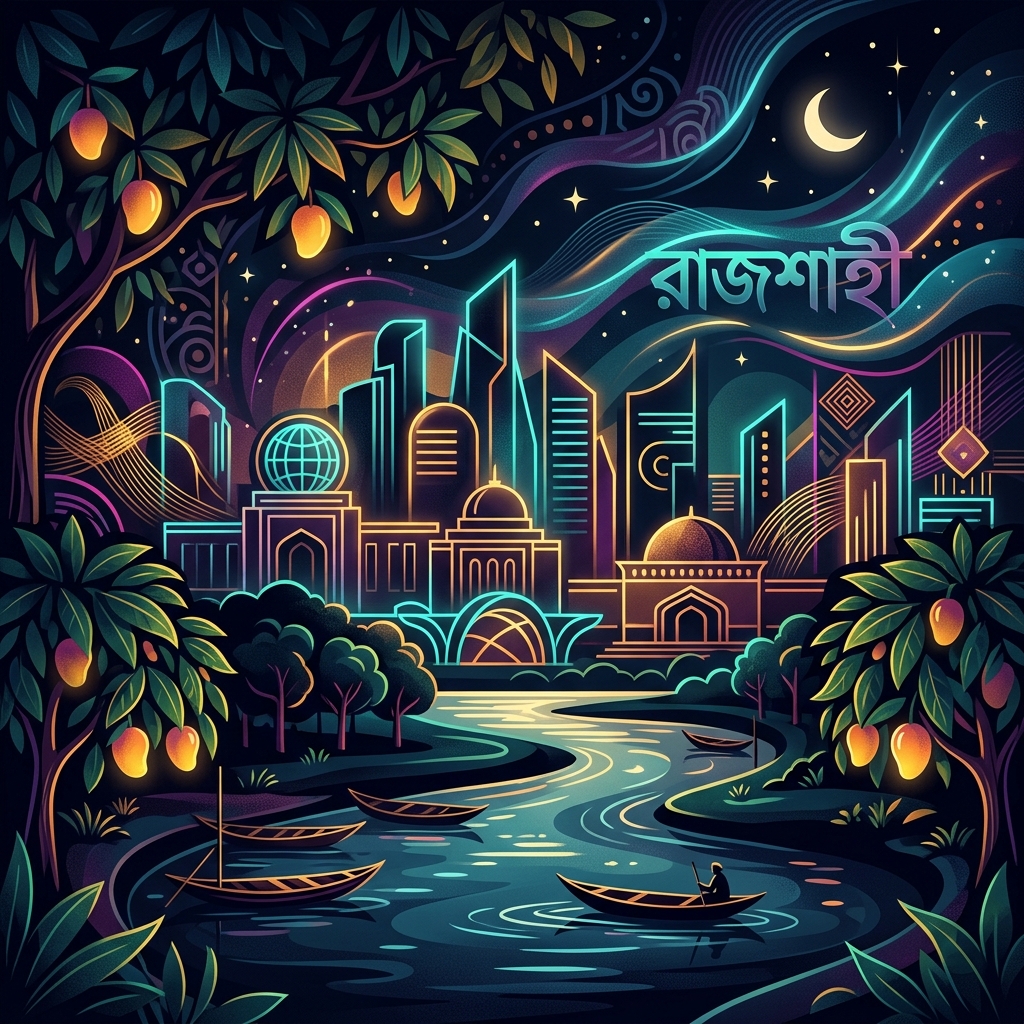
The Padma waterfront is probably the best public space I've seen in any Bangladeshi city. In the evenings, families walk along the embankment. Tea stalls set up. Students from Rajshahi University cycle down. On clear days you can see the Indian side across the water. It's not a dramatic landscape — no mountains, no dramatic skyline — but it has a quiet kind of beauty that Dhaka's concrete never achieves.
The Silk and the Mango
Rajshahi silk (Rajshahi Reshmi) is famous throughout South Asia. The mulberry cultivation and silk weaving industry has existed in the region for centuries. You can find silk products everywhere in the city, and the quality at local shops is far better than what gets sold as "Rajshahi silk" in Dhaka markets.
The mango situation is something I have genuinely strong feelings about. Rajshahi and the surrounding Chapai Nawabganj district produce some of the finest mangoes in the world — not a local exaggeration, an internationally recognised fact. The Fazli, Langra, Gopalbhog, and Himsagar varieties from this region are in a completely different category from the mangoes you find in the rest of the country. If you visit Rajshahi in May or June, the city is effectively in a mango festival for two months. The fruit is everywhere — stacked outside every shop, sold on cycle carts, eaten at every meal.
Missing mango season in Rajshahi is like visiting Japan and missing the cherry blossoms. It's technically fine, but you've missed something.
Rajshahi University
Rajshahi University (RU) — officially the University of Rajshahi — is one of Bangladesh's major public universities and the second-largest university in the country by campus size. The campus itself is enormous, spanning hundreds of acres, and is effectively a small city within the city. There are residential halls, a full hospital, markets, and enough space that cycling is genuinely the most efficient way to get around.
The campus has a particular character — old buildings from the colonial and early post-independence period alongside newer additions, all set within mature trees and landscaping that most urban Bangladesh never gets. On a quiet morning, walking through the campus is one of the more pleasant things you can do in the city.
The university also has an outsized influence on the cultural life of Rajshahi — student events, political activity, cultural programmes, and the sheer number of young people moving through the city gives Rajshahi more intellectual energy than its quiet reputation suggests.
The Border Location
Rajshahi's position directly on the Indian border — specifically facing the Murshidabad district of West Bengal — gives it a distinctive character. The cultural and linguistic connections between this part of Bangladesh and the adjacent Bengali-speaking areas of India are deep. There's a recognisable affinity in dialect, food, and general way of life that you notice if you've spent time in both places.
The Rajshahi border crossing at Sonamashjid connects to the Indian side and is one of the land ports between the two countries. Cross-border trade (official and otherwise) is part of the local economy. The proximity to India is just a fact of daily life in a way that it isn't in most other Bangladeshi cities.
What's Missing
Rajshahi is not without its gaps. The hospital infrastructure outside of the medical college is limited — serious medical cases often go to Dhaka. Job opportunities outside government service, the university sector, and small business are limited, which is why many of Rajshahi's educated young people leave for Dhaka, or eventually further. The city has lost population to Dhaka in the professional class, though the student population keeps it young.
There's also relatively little going on in the evenings compared to a major city. By 9 or 10 pm, most of the city is quiet. For people who grew up here, that's fine — it's how things are. For people arriving from Dhaka, it can feel like the city goes to sleep.
Why It's Worth Visiting
For a Bangladeshi domestic trip, Rajshahi is undervisited relative to what it offers:
- The Somapura Mahavihara at Paharpur (about 80km away) is a UNESCO World Heritage site — the largest Buddhist monastery south of the Himalayas. It's one of Bangladesh's most significant historical sites and is rarely crowded.
- Puthia Rajbari complex, about 25km from the city, has a remarkable collection of Hindu temples built during the Puthia estate era.
- The waterfront.
- The mangoes, obviously.
For a foreigner visiting Bangladesh who has time beyond Dhaka, Rajshahi is a genuine alternative to the standard tourist circuit. It's accessible by train from Dhaka (the Silk City Express is the comfortable option), easy to navigate, and offers a picture of Bangladesh that's completely different from the capital.
Growing up in Rajshahi meant growing up in a city that never made the international news, never featured in the travel magazines, and was mostly unknown to people outside Bangladesh. Having now seen other cities, I think Rajshahi's anonymity is mostly just marketing. The city is worth knowing.