How Flight Pricing Works: Fare Classes, Revenue Management and Why the Same Seat Has 12 Different Prices
The seat next to you cost €40 less. Here's why — and how airlines actually price flights.
You and the person sitting next to you on a flight almost certainly paid different prices. Sometimes the difference is €20. Sometimes it's €400. The seat is identical. The service is identical. The flight is identical.
This is not an accident. It's the result of one of the most sophisticated pricing systems ever built — airline revenue management. Here's how it actually works.
Fare Classes Are Not Cabin Classes
The first thing to understand is that "economy", "business" and "first" are not pricing categories. They're physical product categories. Within economy class, there are typically 8–26 different fare classes — each represented by a single letter.
These fare classes are called booking classes or RBDs (Reservation Booking Designators). Common ones in economy:
- Y — Full-price economy, fully flexible, fully refundable
- B, M, H, Q, V, W, S, T, L, K — Various discounted economy fares, each with different rules
- G, N — Deeply discounted economy, often non-refundable, no changes
Each booking class has its own price, its own change/cancellation rules, and — critically — its own availability. An airline might open 2 seats in K class and 40 seats in Y class on the same flight.
This is why "economy is sold out" often doesn't mean the flight is full. It means the cheap fare classes are closed.
Revenue Management: Selling the Right Seat at the Right Price
Airlines need to solve a specific problem: how do you maximise revenue on a fixed-capacity flight, given that demand changes constantly and unsold seats expire worthless?
The field that solves this is revenue management (RM), and it's been sophisticated since the 1980s. The core idea is simple. Demand for any flight looks roughly like this:
- Leisure travellers book far in advance, are price-sensitive, and flexible on timing
- Business travellers book close to departure, are less price-sensitive, and not flexible
If you fill the plane with leisure travellers at low prices months in advance, you have no room for high-paying business travellers later. If you hold too many seats for business travellers who never materialise, you fly with empty seats.
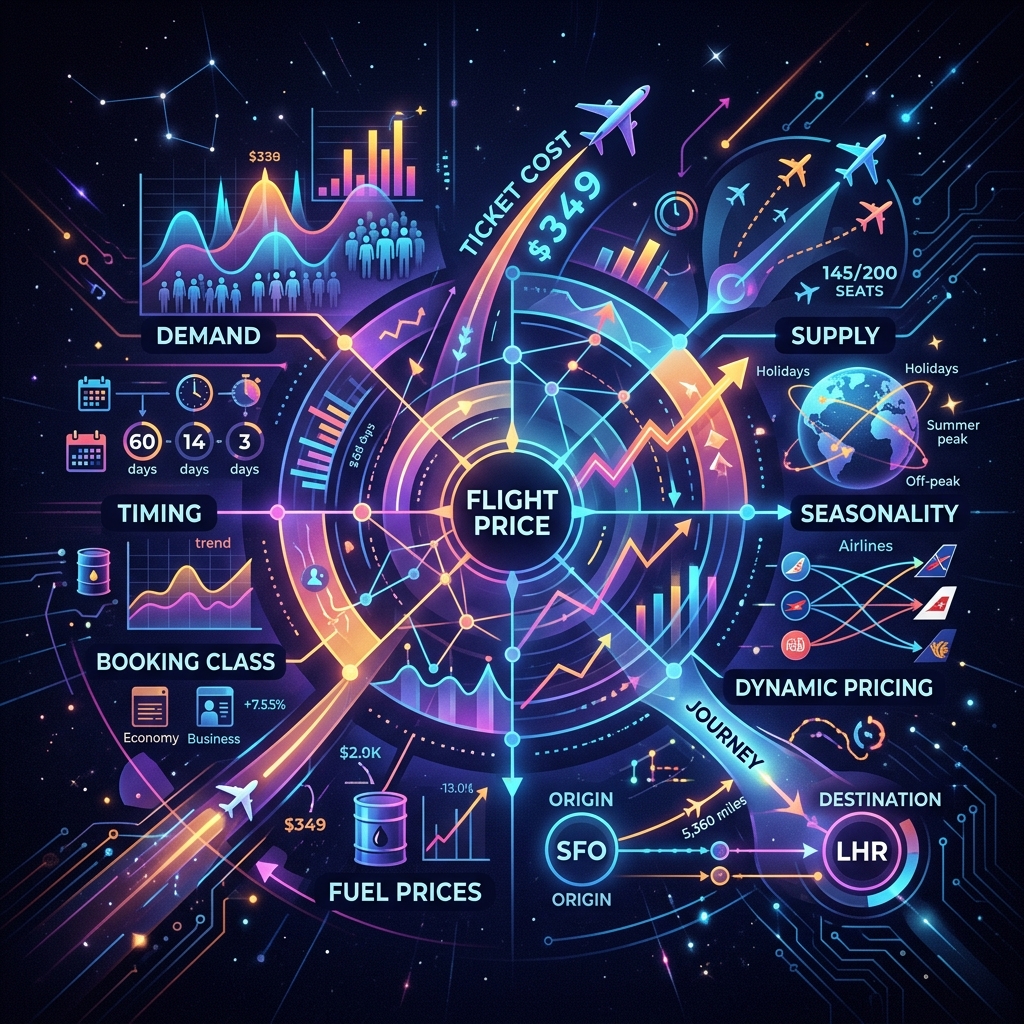
Revenue management systems try to predict — using historical data, seasonality, events, competitive pricing, and machine learning — exactly how many seats to make available at each price point at each point in time before departure.
Why Prices Go Up (and Sometimes Down) as Departure Approaches
The common belief is that prices always go up as a flight approaches. This is roughly true on average but misses the nuance.
Prices typically rise because:
- Cheap fare classes close as they fill up
- Business demand spikes in the last 2 weeks
- The airline knows last-minute buyers have less flexibility
Prices sometimes drop because:
- A flight is not selling as expected and RM opens cheaper classes to stimulate demand
- The airline would rather have a passenger paying €80 than an empty seat paying €0
- Competition from other airlines forces price matching
This is why last-minute deals exist but are unpredictable. You're essentially betting that the airline misjudged demand.
GDS and How Your Travel Agent Sees This
When a travel agent or OTA searches for flights, they query a Global Distribution System (GDS) — Amadeus, Sabre, or Travelport. The GDS sends a pricing and availability request to the airline, which returns the current open booking classes and their prices.
What you see as "€349 economy" is actually something like: "Booking class H on flight LH400, fare basis HEU14P3, base fare €280, taxes €69, conditions: non-refundable, change fee €150, 15kg bag not included."
The fare basis code (HEU14P3 in that example) encodes all the rules of that specific fare. Decode it and you get the exact conditions, including minimum stay requirements, advance purchase requirements, blackout dates, and routing restrictions.
Why Comparison Sites Don't Always Show the Cheapest Price
Metasearch engines (Google Flights, Kayak, Skyscanner) aggregate fares from GDS feeds and direct airline connections. But:
- Not all airlines publish all fares to all GDS systems
- Some airlines have exclusive web fares only available on their own site
- NDC fares (a newer standard for direct airline-to-agent connections) aren't visible on all platforms yet
- Some fares require specific routing or ticketing rules that price comparison tools can't easily surface
The practical implication: for the cheapest fare on a route, check the airline's own website alongside the metasearch results.
Airline Alliances and Interline Pricing
When you book a multi-airline itinerary — say, Lufthansa from Frankfurt to Munich, then Thai Airways from Munich to Bangkok — the pricing gets more complex. These are interline tickets, and they involve negotiated agreements between airlines about how to split revenue.
Codeshares add another layer: the flight operated by Lufthansa but marketed as a United Airlines flight (UA 9001) has separate pricing depending on whether you book through Lufthansa's inventory or United's.
Star Alliance, OneWorld and SkyTeam exist partly to formalise these pricing and interline agreements, and partly to offer consistent frequent flier accrual and redemption rules across member airlines.
What NDC Is Changing
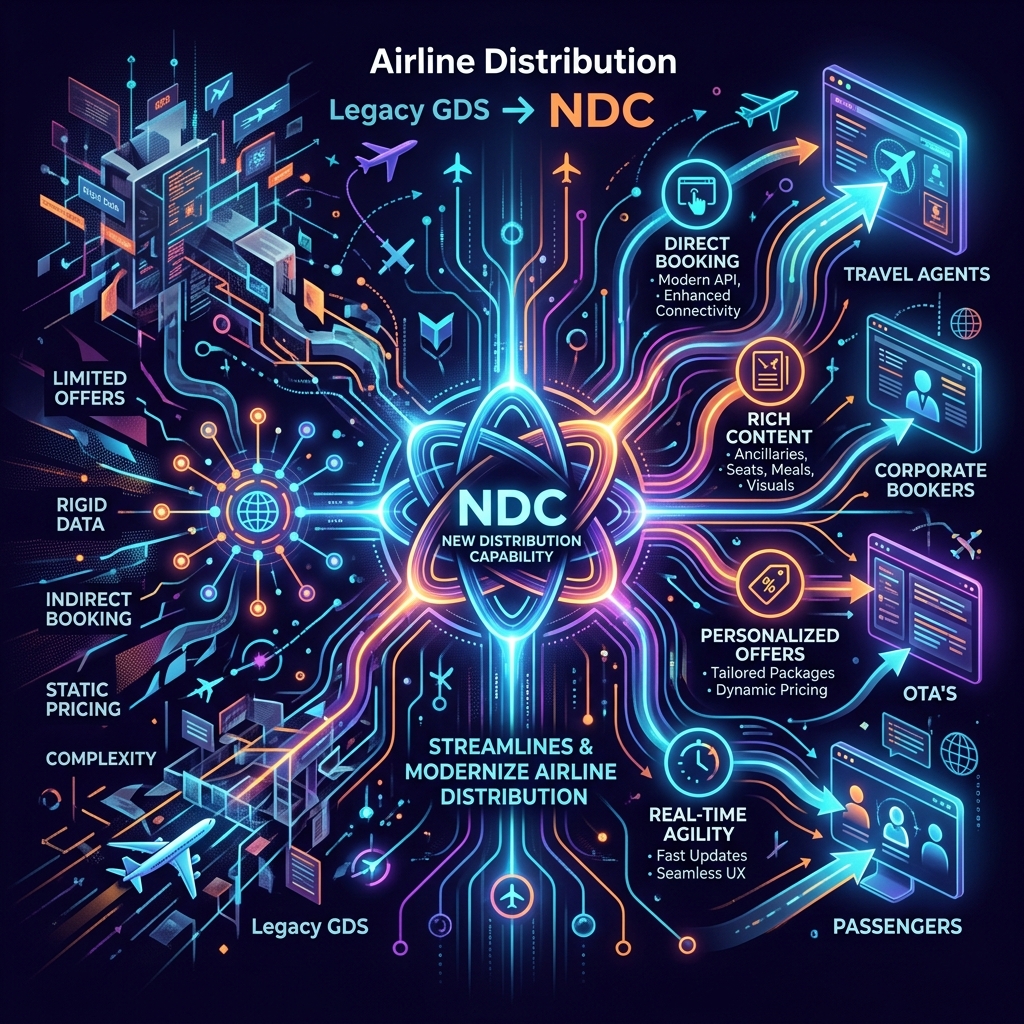
NDC (New Distribution Capability) is an IATA standard designed to let airlines distribute their full product catalogue — including ancillaries, personalised offers, and branded fares — directly to travel agents without going through the GDS.
The traditional GDS shows price and availability. NDC lets airlines show price, availability, plus: which seat rows have extra legroom, what's included in each bundle, upgrade options, and personalised pricing based on loyalty status.
For travellers, NDC means OTAs and travel management companies that support it can show richer information. For the industry, it's a major structural shift that's still playing out — adoption varies significantly by airline and by market.
The Short Version
Flight pricing is not random. It is:
- Structured — by booking classes with predefined rules
- Dynamic — managed in real time by revenue management systems
- Demand-driven — prices reflect predicted demand, not cost
- Distributed — through GDS and direct channels, each showing different subsets of available fares
The next time you see a wide price range for a flight, you're seeing revenue management at work — and the answer to "why does it cost that?" is almost always: because that's what the model predicted someone like you would pay.