What is NDC and Why Airlines Are Moving Away From GDS
The travel distribution system that's been running since the 1970s is finally being disrupted. Here's what NDC means and why it matters.
If you've ever wondered why the airline's own website sometimes shows cheaper fares than Expedia or your travel agent, the answer involves a 50-year-old technology monopoly and an IATA standard called NDC.
The Problem NDC Is Trying to Solve
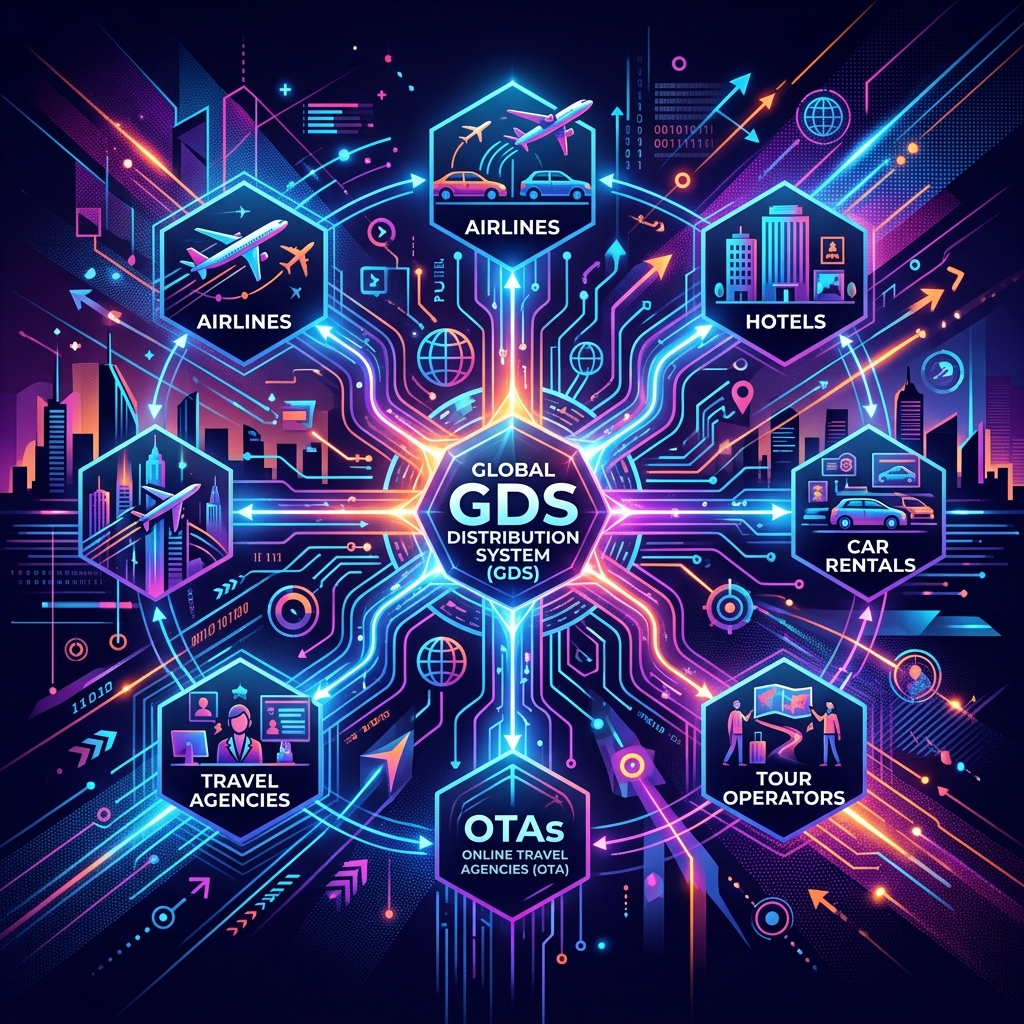
Global Distribution Systems — Amadeus, Sabre, Travelport — were built in the 1960s and 70s to electronically connect airlines with travel agents. Before GDS, booking a flight meant calling an airline directly. GDS created a single interface where agents could search and book any airline, which transformed the industry.
The original GDS protocol (EDIFACT, then later its derivatives) was designed for one thing: price and seat availability. A query goes in, a fare and a booking class come back. That's it.
This worked fine when airline products were simple: economy, business, first class, with a handful of fare rules. It does not work well in 2025, when airlines sell:
- Bundled fare families (Lite, Basic, Flex, Business)
- Ancillaries priced per passenger (bags, seats, meals, lounge access)
- Personalised offers based on loyalty status
- Dynamic pricing that changes by the millisecond
- Upgrade paths and bundle modifications
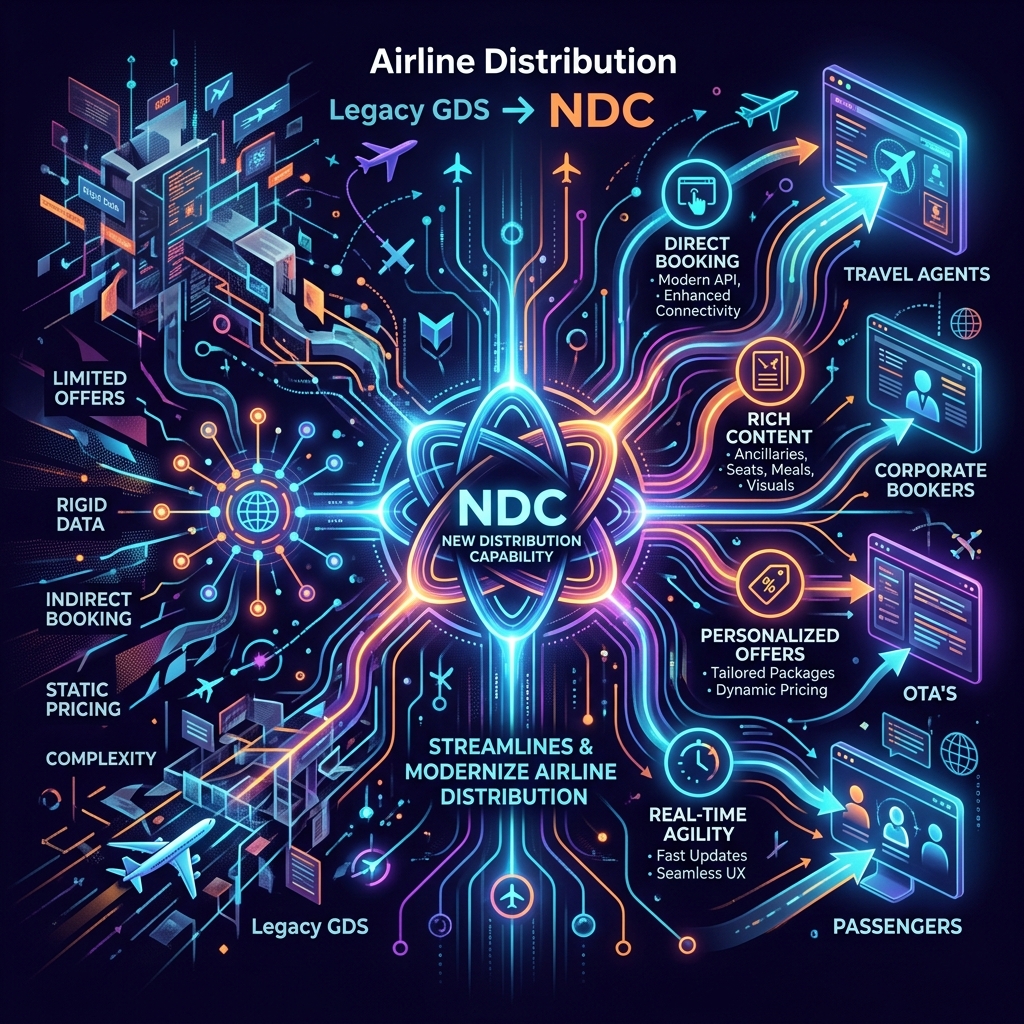
The GDS pipe wasn't built to carry any of this. Airlines could only communicate via rigid, decades-old EDIFACT messages that had no field for "whether a bag is included in this fare" or "here is a personalised bundle for this loyalty member."
The result: airlines were forced to move their richest products — their best bundles, their most competitive ancillary prices, their personalised offers — to their own direct channels. Their GDS fares were stripped-down commodity prices. And then they got criticised for having higher fares on GDS.
What NDC Is
NDC (New Distribution Capability) is an IATA XML-based communication standard, published in 2012 and now on its 21.3 release. It defines a modern API format that allows airlines to distribute their full product catalogue to any channel — travel agents, OTAs, corporate booking tools — without going through the GDS intermediary.
The key technical difference:
- GDS (EDIFACT): Request-response with predefined fields. Returns fares and availability in a fixed format.
- NDC (XML API): Rich, flexible data exchange. Returns offers that can include full fare descriptions, ancillary offers, images, seat maps, bundle options, and personalised pricing.
NDC is a standard, not a product. Every airline that implements NDC builds their own NDC API according to the spec. A travel agent or OTA that wants to access NDC content from Lufthansa, British Airways, and Emirates needs to connect to three separate NDC APIs — or use an aggregator that normalises them.
Who's Who in the NDC Ecosystem
Airlines: Lufthansa Group was among the first movers, imposing GDS distribution surcharges to push agents toward NDC. British Airways (IAG), American Airlines, and Air France-KLM have all made significant NDC investments. LCCs (low-cost carriers) like easyJet and Ryanair are largely irrelevant here — they never heavily distributed through GDS to begin with.
GDS companies: Amadeus, Sabre and Travelport are not standing still. They've built NDC aggregation layers, so travel agents can access NDC content through the same GDS interface they already use — Amadeus just handles the translation behind the scenes. This is important: most travel agents aren't connecting directly to airline NDC APIs.
NDC aggregators / new entrants: Companies like Duffel, Verteil (now part of Amadeus), and others built pure NDC aggregation platforms. They normalise content from multiple airline NDC APIs into a single connection. OTAs building new systems sometimes start with these aggregators instead of GDS.
Corporate booking tools: SAP Concur, Cytric, and similar corporate travel management tools are adding NDC support to surface richer airline content to business travellers.
What Changes for Travellers
In theory: you should eventually see the same prices and options regardless of where you book — airline site, OTA, or travel agent. A travel agent using NDC should be able to sell you the same bag inclusion, same seat selection options, same upgrade paths as the airline's own website.
In practice: NDC adoption is still uneven. Many travel agencies and corporate booking systems are still primarily GDS-based. The rich content NDC promises isn't always flowing through. Some airlines have more mature NDC implementations than others.
The areas where NDC is making the most difference right now:
- Fare families: Agents can now see and sell bundle tiers (Basic/Flex/Business) rather than just a flat economy fare
- Ancillaries: Some NDC implementations let agents sell bags and seats at the same price as the airline direct
- Reduced GDS surcharges: Airlines that used to penalise GDS bookings with surcharges are removing them for NDC bookings
The OTA Development Challenge
Building an OTA flight search today means a different set of decisions than it did 5 years ago:
- Connect to GDS only (comprehensive coverage, legacy content, limited product richness)
- Connect to NDC aggregators (better content for supported airlines, coverage gaps)
- Connect directly to airline NDC APIs (maximum richness, maximum complexity)
- Hybrid approach (GDS for coverage, NDC for specific carriers)
Most mid-size and larger OTAs are running hybrid approaches. The technical complexity of managing multiple NDC connections — with different schema versions, different supported features, different authentication methods — is significant.
The airline NDC API itself is also stateful in a way GDS isn't. GDS pricing is transactional: search, price, book. NDC uses an offer/order model: search returns offers, you select an offer, you create an order, you service the order. The shopping basket semantics are fundamentally different, which requires rethinking booking engine architecture.
Where Things Are Headed
IATA has a target — often called "NDC 100%" or "IATA ONE Order" — of moving the entire industry to modern standards. ONE Order goes further than NDC: it replaces the traditional paper ticket and PNR (Passenger Name Record) with a single order record.
Adoption timelines keep shifting. The technology is largely ready. The commercial, contractual, and organisational inertia in a global industry with tens of thousands of travel agencies, hundreds of airlines, and multiple GDS incumbents is enormous.
The realistic picture: NDC will continue to grow its share of airline bookings, particularly in markets and segments where airlines have invested heavily in their direct NDC APIs. GDS won't disappear — it's too deeply embedded and provides too much value (aggregation, settlement, automation) to be replaced quickly. The industry will likely run both in parallel for the next 10–15 years.
For OTA developers and travel tech teams: if you're not already thinking about NDC integration, it's time to start.