How eSIM Works: The Technical Architecture Behind Eliminating the Physical SIM
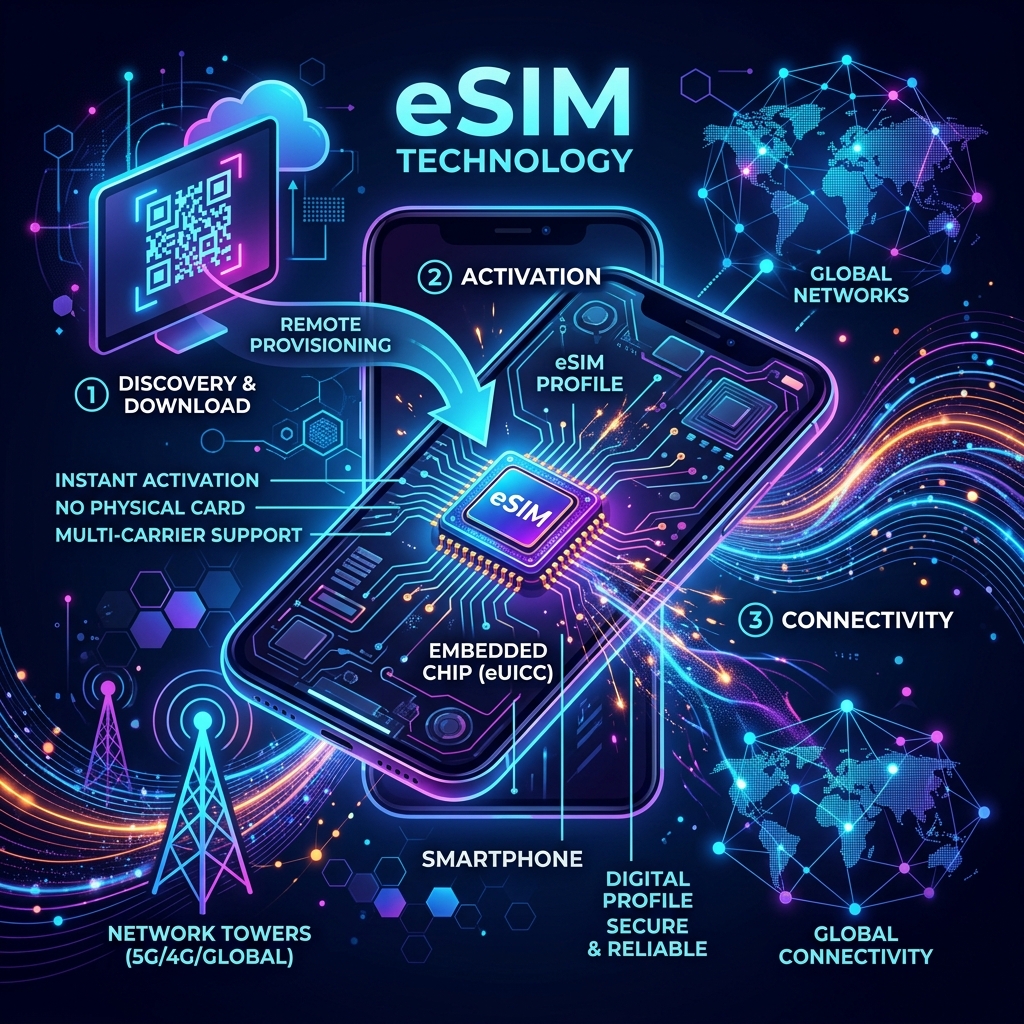
eSIM is just a SIM card without the plastic — except the architecture underneath is completely different. Here's what's actually happening.
The marketing message around eSIM is simple: no plastic card, switch carriers in minutes. But "embedded SIM" sounds simpler than it is. The architecture that makes eSIM work is a complete redesign of how mobile identity and provisioning work — and understanding it explains both the capabilities and the limitations of the technology.
What a Traditional SIM Actually Does
Before understanding eSIM, it helps to understand what a SIM card is doing in the first place.
A SIM (Subscriber Identity Module) card stores:
- IMSI (International Mobile Subscriber Identity): a 15-digit number that uniquely identifies a subscriber on a network
- Ki (Authentication Key): a 128-bit cryptographic key used to authenticate the subscriber to the network
- A small amount of storage for contacts and SMS
When your phone connects to a network, it performs a mutual authentication challenge with the operator's Authentication Centre using the Ki. Neither side ever transmits the Ki — they use it to prove to each other that they hold the same secret. This is how a network knows the subscriber is legitimate.
The physical SIM card is a tamper-resistant secure element — a tiny computer designed to be very hard to extract information from and to refuse operations that haven't been authorised.
What eSIM Changes
eSIM (embedded SIM, formally called eUICC — embedded Universal Integrated Circuit Card) is a SIM chip soldered directly onto the device's motherboard rather than inserted in a tray.
The chip itself does the same job as a physical SIM — it's still a secure element storing cryptographic keys. The fundamental difference is remote SIM provisioning: instead of a SIM card being pre-programmed by an operator and physically handed to the subscriber, the profile (the set of IMSI, Ki, and operator configuration data) is downloaded over the air.
This means a single eSIM chip can hold multiple carrier profiles and switch between them without any physical change.
The Technical Architecture: GSMA SGP.22
The eSIM standard for consumer devices is GSMA SGP.22 (consumer eSIM), also called RSP — Remote SIM Provisioning. The architecture has five main components:
eUICC (the chip): The secure element on the device. Stores profiles, performs authentication, and executes secure operations. Has a unique identity (EID — eUICC Identifier) and comes pre-loaded with root certificates for trusted SM-DP+ servers.
SM-DP+ (Subscription Manager Data Preparation Plus): An operator-run or third-party server that prepares, stores, and delivers eSIM profiles. Think of it as the secure profile packaging and delivery system. Apple, for example, operates SM-DP+ infrastructure for consumer eSIM. So does Thales, Giesecke+Devrient, and specialist eSIM platform vendors.
SM-DS (Subscription Manager Discovery Service): A discovery server that the device queries to find out if there's a pending profile download. This is how your phone knows to prompt "there's a profile waiting" without you manually entering a server address.
LPA (Local Profile Assistant): Software on the device that manages the interface between the user/app and the eUICC. The LPA handles the UI for downloading, switching, and deleting profiles.
CI (Certificate Issuer): A trusted entity (currently GSMA) whose root certificates are embedded in every eUICC, establishing the trust chain for SM-DP+ servers.
The Profile Download Flow
When a traveller buys an eSIM data plan, here's what actually happens:
-
Purchase: You buy a data plan from an eSIM provider (Tourist eSIM, Airalo, Holafly, or a direct carrier eSIM). The eSIM platform provider has a pre-purchased allocation of profiles from a carrier in your destination country.
-
Profile preparation: The SM-DP+ prepares an encrypted profile package containing the subscriber identity (IMSI), authentication key (Ki), and carrier configuration for your specific device.
-
Activation code: You receive an activation code (AC, formatted as
LPA:1$smdp.example.com$MATCHING-ID) or a QR code encoding the same information. The matching ID is a ticket that retrieves your specific prepared profile. -
Device download: Your device's LPA connects to the SM-DP+ server over HTTPS. Server and eUICC mutually authenticate using the certificate chain anchored at the GSMA CI root. The profile is transferred encrypted and signed.
-
Profile installation: The profile is decrypted and installed inside the eUICC secure boundary. The Ki never leaves the SM-DP+ or the eUICC in plaintext at any point in the flow.
-
Network attachment: The device enables the profile, the baseband connects to the destination carrier's network, and the standard SIM authentication (using the installed Ki) takes place.
The Multi-Profile Capability
A single eUICC can store multiple profiles simultaneously (typically 5–10 depending on storage). Only one profile can be active at a time, but switching is fast — a few seconds with no physical action.
This is what enables the travel eSIM use case: you keep your home carrier SIM/profile for calls and messages, download a local data eSIM for the destination country, use the local data while abroad, and switch back when you return. No plastic, no queuing at a carrier kiosk, no hunting for a SIM ejector tool.
The Business Model of eSIM Providers
eSIM marketplaces like Tourist eSIM, Airalo, and Holafly operate as resellers of carrier wholesale capacity. The flow:
- A local carrier in, say, Japan sells wholesale data capacity to eSIM wholesalers
- eSIM providers (the marketplace) buy blocks of profiles/data from these wholesalers
- A traveller buys a Japan data plan from the marketplace
- The marketplace assigns a profile from its inventory and delivers it to the traveller's device
- The traveller uses data, which runs through the local Japanese carrier's network
The margin comes from the difference between the wholesale rate and the retail price. High-volume marketplaces have negotiating leverage to get better wholesale rates.
Why eSIM Isn't Available Everywhere Yet
Despite being years old, eSIM has gaps:
Device support: eSIM requires hardware support in the device. All modern flagship smartphones (iPhone XS onwards, most Pixels, Samsung S20 onwards) support consumer eSIM. Many mid-range and budget phones still use physical SIM only.
Carrier support: Even where devices support eSIM, not every carrier has activated their SM-DP+ infrastructure or allows eSIM for all plan types. Prepaid eSIM availability specifically varies enormously.
Dual physical SIM markets: In markets where dual physical SIM cards are standard (parts of Asia, Africa), device variants may have the eSIM slot replaced with a second physical SIM tray. Devices sold in China, for example, typically don't have eSIM due to regulatory requirements.
eSIM locking: Some carriers have locked their SM-DP+ to only allow their own profiles, limiting which eSIMs can be installed. Apple's Apple SIM faced this issue with some carriers.
iSIM: The Next Step
iSIM (integrated SIM) takes this further: instead of a separate eUICC chip, the SIM functionality is integrated directly into the device's System-on-Chip (SoC). Qualcomm has developed iSIM-capable chipsets, and some devices (Motorola's 2022 Razr+) shipped with iSIM.
The functional result is similar to eSIM — remote provisioning, multi-profile support — but the implementation is even more embedded and potentially more power-efficient.
What This Means in Practice
For travellers: eSIM is genuinely better than hunting for local SIM cards if your device supports it and you're going somewhere with good eSIM marketplace coverage (Western Europe, East Asia, North America). The convenience is real.
For developers building in the space: the SGP.22 architecture means integrating with an SM-DP+ platform (not building one yourself). The main integration complexity is profile lifecycle management, order fulfilment webhooks, and handling the edge cases (profile download failures, device incompatibility, network attachment issues).
For the industry: eSIM is still mid-adoption. Physical SIM cards aren't going away this decade. But the trajectory is clear.