Bangladesh's Software Industry: What's Actually Happening in Dhaka's Tech Scene
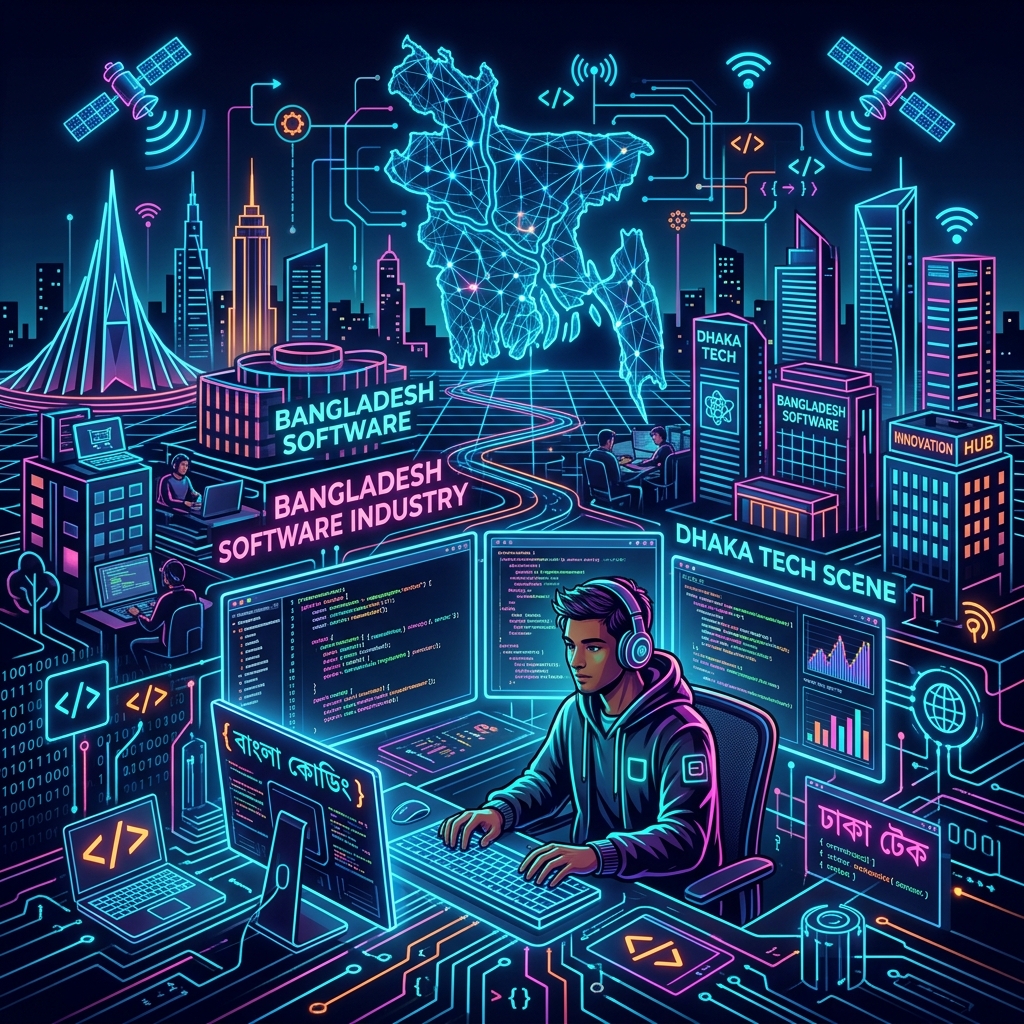
Observing the Bangladesh tech sector during its growth years — what the industry looked like when it was finding its footing.
By 2019, Bangladesh's IT sector had been growing for a decade but was still in the middle of figuring out what it wanted to be. The government had been pushing "Digital Bangladesh" as a national programme since 2009. Tech parks were being built. Freelancing on international platforms was booming. Local startups were getting early-stage funding for the first time. And the number of people graduating with IT-related degrees was growing faster than the market knew what to do with.
Here's what the industry looked like — observed from within it, as someone building independently from the beginning rather than climbing any employment ladder.
The Two Tracks
Bangladeshi tech in this period ran on two largely separate tracks — and where you positioned yourself determined everything about your income, your hours, and your trajectory.
The international track: Bangladesh consistently ranked in the top 5 countries globally for earnings on platforms like Upwork and Fiverr. Developers, designers, and digital marketers were earning in USD, EUR, and GBP doing work for international clients. A serious independent developer operating at this level earned far more than any comparable salaried position in Bangladesh — the ceiling was essentially determined by skill and client quality, not by what the local market could pay.
The international freelancing community had its own ecosystem: Facebook groups, Upwork training operations, community figures coaching people through profile strategy. Self-organised, informal, and effective.
The local employment track: Software companies, multinational offices, banks, telecoms, and NGOs employed developers locally — structured hours, taka salaries, more predictable if more limited. The most ambitious people in this track were usually building toward the international one or toward their own ventures.
The dynamic was clear: the developers who built early and built independently were structurally ahead. Those who spent years in local employment found the salary ceiling relatively low and the exit path to something better required starting over with the skills that employment hadn't pushed them to develop.
What Companies Were Actually Building
Local tech companies in Bangladesh fell into roughly these categories:
Software factories: Outsourcing companies that took projects from international clients (often in the US, UK, or Middle East) and executed them with local developers. These ranged from serious operations with strong quality control to shops that overpromised and underdelivered, creating the reputation problems that all outsourcing markets struggle with.
Product companies: Smaller in number but growing — companies building specific products for the Bangladeshi or regional market. Shajgoj (beauty and lifestyle), Shikho (education), Shohoz (ride-sharing and logistics), Chaldal (grocery delivery), Pathao (ride-sharing) — these were among the local startups that gained traction in this period.
BFSI tech: Banks and financial institutions were a major employer of software developers for internal systems. Dutch-Bangla Bank, BRAC Bank, Bkash (mobile financial services), and the Digital Financial Services sector more broadly employed significant numbers of developers.
Telecom platforms: Grameenphone, Banglalink, Robi — the major mobile operators — all had substantial tech teams building and maintaining platforms, particularly as they launched mobile financial and content services.
NGO and development sector: Bangladesh has a large international development sector, and organisations like BRAC (one of the world's largest NGOs) had significant technical programmes. There was a particular niche for developers who understood both technology and development sector reporting requirements.
The Salary Reality
In 2019, developer salaries in Dhaka:
- Junior developer (0–2 years): 20,000–35,000 BDT/month (~$240–420)
- Mid-level (3–5 years): 40,000–70,000 BDT/month (~$470–830)
- Senior (6+ years): 70,000–120,000 BDT/month (~$830–1,420)
- Team lead / architect: 100,000–180,000 BDT/month (~$1,200–2,100)
These numbers sound low in absolute terms but need to be contextualised. Cost of living in Dhaka for a bachelor or young professional was significantly lower than these numbers would imply in a Western context. A decent flat share in Mirpur or Mohammadpur cost 5,000–8,000 BDT/month. Daily meals could be managed on 300–400 BDT/day without much restriction. Transportation costs were low.
Still, the ceiling was visible and felt. A senior developer hitting 120,000 BDT was doing well locally but looking at international alternatives.
The Skill Gap Problem
The Bangladesh tech sector's most persistent complaint from employers: the gap between what universities produced and what industry needed.
University curricula taught theory — data structures, algorithms, operating systems, database principles — and did this adequately for the foundational concepts. What they didn't teach: modern frameworks and tools, version control as standard practice, software testing, agile workflow, deployment and DevOps basics, API design, and the general professional software development practices that international employers assumed were universal.
The practical result: companies hiring fresh graduates had to run their own informal onboarding programmes to bridge the gap. The graduates who had done significant freelancing or personal projects needed significantly less of this.
This created a two-tier job market: graduates who had built things (GitHub portfolio, freelance projects, open-source contributions) entered at a different level than graduates who had only academic experience. The divide was visible, acknowledged, and hadn't been closed by 2019.
The Startup Wave
2017–2020 was a period of growing startup activity in Bangladesh. Shohoz had raised funding. Pathao went regional. Shajgoj was growing. Chaldal, which had started earlier, was demonstrating that e-commerce could work at a meaningful scale in Dhaka's logistics-challenged environment.
International VCs were beginning to look at Bangladesh. Shunwei Capital (Chinese VC) backed Shohoz. Global Ventures, Openspace, and others started appearing in early conversations about the Bangladesh market.
The ecosystem was still nascent compared to India or Southeast Asian markets. The angel network was thin. The seed funding gap (between friends-and-family rounds and Series A) was real and painful for early startups. Exit examples were still very limited — no significant acquisitions or IPOs of tech companies had yet provided the model for what a successful outcome looked like.
But the direction was clear and the energy was there. People who had worked for a few years and accumulated skills were starting companies. A startup culture — Slack channels, co-working spaces like Impact Hub, small networking events — was forming.
Bangladesh as a Service Destination
One thing that didn't get enough credit externally: Bangladesh was becoming a meaningful destination for technical work outsourced from elsewhere in South Asia, not just from Western markets.
Bangladeshi developers were doing work for Indian companies. Bangladeshi graphic designers were doing work for Middle Eastern marketing agencies. As rates in India rose and the freelancing platforms equalised access to international clients, Bangladesh (with good English, strong math and science education, and lower rates than Indian equivalents) was attracting more of this work.
The flip side: the middle layer of Bangladeshi tech — the developers who were good enough for domestic work but not breaking into the higher-paying international tracks — was getting squeezed. Competition from developers in other emerging markets was intensifying on the platforms, and the race to the bottom on price was a structural problem that individual developers couldn't solve alone.
What It Felt Like From Inside
Working in tech in Dhaka in this period had a particular energy. There was a genuine sense that the industry was growing fast enough that significant opportunities were coming — that if you could build skills and stay in the market, the next five years would be better than the last five.
There was also the exhaustion of the city itself — the commutes, the density, the constant noise of construction everywhere as Dhaka tried to build its way out of its infrastructure deficit. The people who were most successful at navigating the Dhaka tech scene in this period tended to live as close to work as possible and structure their professional life to minimise the friction the city imposes.
Looking back from outside Bangladesh, the period from 2017 to 2020 was genuinely a formative time for the industry. The startups that launched then are the companies that are now established. The developers who built skills then and stayed in the market moved into senior and leadership roles that paid significantly more than the numbers above. The inflection point happened quietly, without much international notice.