The German Tech Scene: Cities, Companies, Culture and What Makes It Different
Germany's tech industry is large, export-driven, and genuinely different from the Silicon Valley model. Here's an honest picture.
Germany has the fourth-largest economy in the world and is home to some of the world's most recognisable industrial brands. What it doesn't have is the kind of concentrated tech scene you find in San Francisco, London, or Singapore. The German tech industry is more distributed, more industry-embedded, and runs on different values than the startup-culture model that dominates tech media coverage.
This is what the German tech scene actually looks like.
The Structural Difference: Industrial Tech vs Consumer Tech
The dominant narrative in global tech is consumer internet — social networks, consumer apps, B2C SaaS. Germany's tech industry is disproportionately industrial and B2B:
- Automotive software (Volkswagen Group, BMW, Mercedes-Benz digital divisions)
- Industrial IoT and automation (Siemens, Bosch, SAP)
- Enterprise software (SAP is headquartered in Walldorf and is the world's largest ERP vendor)
- Logistics tech (DHL Innovation Hub, DB Schenker, FlixBus)
- Fintech (N26, Solaris, Trade Republic, Scalable Capital)
- Health tech (Fresenius Digital, Philips Germany, numerous startups)
- E-commerce (Zalando, Otto Group, About You)
If you want to work on consumer social products, Germany is not the place. If you want to work on industrial software, enterprise systems, fintech, or logistics tech — Germany has deep ecosystems.
The Cities
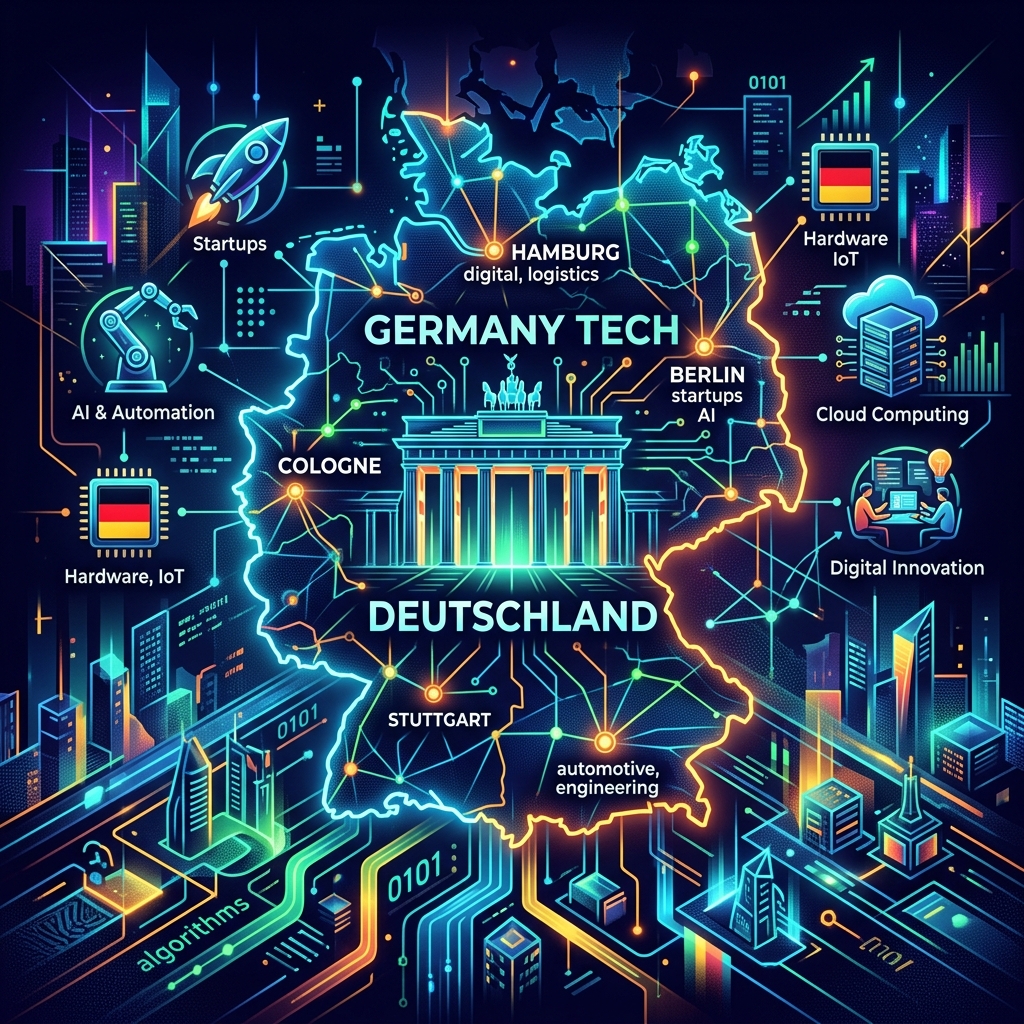
Berlin is Germany's most internationally recognised startup city and has the highest concentration of VC-backed companies. The ecosystem includes major companies (Zalando, Delivery Hero, HelloFresh, N26) and a dense layer of early-stage startups. The tech community is international — English is the working language at many companies. Cost of living is rising but still lower than London or Amsterdam. The trade-off: Berlin salaries are the lowest of the major German tech cities.
Munich is the economic powerhouse. Home to BMW, MAN, Siemens, Linde, and dozens of large technology companies. The startup ecosystem is smaller than Berlin but growing, anchored by TU Munich (one of Europe's top technical universities) and a well-resourced VC community. Salaries are significantly higher than Berlin. So is cost of living — Munich consistently ranks as one of the most expensive cities in Germany.
Frankfurt is the financial capital — Deutsche Bank, Commerzbank, European Central Bank, and hundreds of smaller financial institutions and fintechs. The European Internet Exchange (DE-CIX) is here, making Frankfurt the internet infrastructure hub of Europe. For fintech, cybersecurity, and financial technology, Frankfurt is the obvious location.
Hamburg has a strong media and e-commerce heritage — Otto Group (one of the world's largest online retailers), About You (fashion e-commerce), Xing (the German professional network), and a growing games industry. The culture is more conservative than Berlin, which many find a better fit for serious product work.
Stuttgart and the Southwest is industrial tech country — Bosch and Daimler have enormous software development operations here. The work is serious, the salaries are competitive, and the quality of life is high. Less startup activity, more established engineering culture.
Cologne and Düsseldorf (Rhine-Ruhr region) have large media companies (RTL, Deutsche Telekom is nearby in Bonn), advertising tech, and e-commerce. The region has the largest population concentration in Germany but is underrepresented in global startup coverage.
German Startup Ecosystem: The Honest Picture
Germany has produced genuine tech successes: SAP (founded 1972, still the world's leading ERP company), TeamViewer, Trivago, HelloFresh, Auto1, and N26 have all been significant. Porsche and Volkswagen have launched major digital subsidiaries (Cariad, VW Software).
The honest assessment of the German startup ecosystem compared to, say, Israel, the UK, or Sweden:
Strengths:
- Access to industrial clients for B2B startups — German Mittelstand companies are early customers for enterprise software
- Strong engineering talent from excellent technical universities
- EU market access from day one
- Government grant programmes (EXIST, KfW programmes) provide startup financing
- Growing VC ecosystem, particularly in Berlin and Munich
Challenges:
- German VC investment per capita is still well below the US and UK
- Risk aversion in the culture makes early sales cycles to German enterprise clients slow
- Employment law makes fast scaling and layoffs more complex than in the US
- Tax treatment of stock options has historically been less founder-friendly (improving with the Future Financing Act / Zukunftsfinanzierungsgesetz)
- Brain drain to US companies offering higher total compensation including equity
The net result: Germany produces solid B2B and industrial tech companies more reliably than it produces consumer internet unicorns. When you see a German tech startup succeed, it's often because they solved a real, specific industrial or enterprise problem rather than finding a consumer market at scale.
Work Culture in Tech
German tech culture has a few consistent characteristics that cut across company types:
Thoroughness over speed. The German engineering tradition values quality and completeness over shipping fast and iterating. This creates products that are well-engineered but sometimes slow to market. Product teams often find the cultural alignment between "move fast" and "do it right" harder in Germany than in other markets.
Documentation and process. Internal processes are taken seriously. Code reviews, architecture decisions, security considerations — these get documented rather than assumed. This can feel bureaucratic to developers used to moving fast, but produces more maintainable systems over time.
Work-life boundaries. In most established German tech companies, evenings and weekends are personal time. Expecting developers to be always available is genuinely unusual and often contractually not permitted. This is not slacking — it's a cultural expectation that most German workers actively defend.
Flat vs hierarchical. This varies dramatically by company type. Berlin startups tend to be flat and English-speaking. Traditional German companies have clear hierarchies and German-language internal culture. International mid-size companies (like large B2B SaaS firms) fall somewhere in between.
Works Councils. Companies above a certain size have employee-elected works councils (Betriebsrat) with legally mandated rights to co-determine decisions on working conditions. This is foreign to developers from most other markets but is a normal part of German employment relations. Tech companies with works councils are not unusual.
The Mittelstand: The Invisible Layer
One of the most important things to understand about Germany is the Mittelstand — the layer of medium-sized companies (broadly: 50–500 employees, privately owned, often family businesses) that employ the majority of German workers and generate a large share of exports.
Many Mittelstand companies are hidden champions: world market leaders in niche industrial products that most people have never heard of. The company that makes 80% of the world's screwdriver bits, the manufacturer of precision medical instruments for MRI machines, the software that runs European shipping container tracking — these are Mittelstand companies.
Increasingly, these companies are hiring software developers as they digitise their operations, integrate ERP systems, build IoT platforms, and launch digital service offerings alongside their physical products. Working for a Mittelstand company offers:
- Job stability (Mittelstand companies rarely do mass layoffs)
- Interesting domain problems (how do you digitise a 100-year-old industrial process?)
- Less competitive compensation than FAANG or top startups
- Excellent work-life balance
- Possibly a 50-minute commute if the company is in an industrial area rather than a city centre
Remote Work: Where Germany Stands
Germany adopted remote work later and less enthusiastically than some other markets. Many large established companies are pulling back toward office presence — Deutsche Bank, Siemens and others have issued return-to-office policies.
The tech sector is more mixed. Berlin startups and international tech companies operating from Germany often maintain remote-friendly policies. Traditional industrial companies increasingly want engineers on-site, particularly for roles with hardware or manufacturing integration.
The home office tax deduction (up to €1,260/year for 2023 and beyond) is a small recognition of remote work costs. The legal framework for Homeoffice (working from home) is clearer than it was pre-pandemic, with employee and employer obligations around equipment, data protection, and working hours now better established.
Getting In: For International Developers
The path for non-EU developers is clearer than it used to be, though not frictionless:
- EU Blue Card: Salary threshold for IT roles is below the general threshold (€45,300 gross in 2024 for shortage occupations). With a degree and a job offer above that threshold, this is the most common path.
- Chancenkarte: Introduced in 2024, allows entry to job-search without a prior job offer, based on a points system.
- Language: English is sufficient for many tech roles, particularly in Berlin and at international companies. German at B1+ is needed for daily life and opens substantially more opportunities.
- Visa processing time: Plan for 4–12 weeks for initial visa processing through German embassies, which varies by home country and consulate capacity.
The German tech scene rewards patience, depth, and engineering rigour. It's not the place for rapid pivots, move-fast-break-things culture, or consumer app startups. It is one of the world's best environments for serious industrial software, enterprise systems, and technology that works.