What People Actually Eat in Bangladesh: A Realistic Food Guide From Someone Who Lived It
The 'national dish' thing never tells you what people eat for breakfast on a Tuesday. Here's what Bangladeshi food actually looks like day to day.
Every country guide includes a section on national cuisine. Every section on Bangladeshi cuisine mentions hilsa fish, biryani, and possibly mishti doi. All of this is accurate and all of it is a tiny sliver of what Bangladeshis actually eat.
Having grown up in Rajshahi and then spent years living in Dhaka, here's what food actually looks like on a normal day, from someone who ate it every day rather than visiting for a week.
What a Day of Eating Looks Like
Breakfast in most Bangladeshi homes is not the elaborate thing that tourism guides suggest. The average weekday breakfast is light:
- Ruti (flatbread) with vegetables, lentils, or an egg, made fresh in the morning
- Or paratha (layered fried flatbread) from a street stall, eaten with a fried egg or curry
- Or, if you're in a hurry, nothing much at all — some people eat their first proper meal at lunch
In Rajshahi, muri (puffed rice) with mustard oil and green chilli is a common morning thing — it sounds strange but becomes completely normal. In Dhaka, the tea stall by the roadside at 7am serves paratha, boiled egg, and chaa (tea) and is doing serious business.
Lunch is the largest meal of the day for most Bangladeshis. In a home setting, this means rice — always rice — with several accompaniments:
- Dal (lentil soup, usually masur or mung) — almost every meal has dal
- At least one vegetable preparation (aloo bhaji, begun bhaji, shim, or whatever's seasonal)
- Some form of fish or meat if affordable
- The fish is almost always fresh — Bangladeshi households buy fish daily, not in advance
In Dhaka, the midday meal at local dhabas (neighbourhood restaurants) follows a fixed-plate logic: rice, dal, one vegetable, one fish or chicken — quick, straightforward, and the same everywhere from Mirpur to Motijheel. It's one of the more democratic aspects of urban Bangladeshi food culture: the logic of the meal is identical regardless of the establishment.
Dinner is lighter, typically rice again with whatever wasn't finished at lunch, or ruti with a curry.
Rice Is Not Optional
This sounds like I'm overstating it, but I'm not: rice is not a side dish in Bangladesh. It's the meal. Everything else — fish, vegetables, dal, meat — is accompaniment to the rice. The terminology reflects this: "bhat khawa" (eating rice) is the phrase for having a meal. If you haven't had rice, you haven't eaten.
The varieties of rice matter. Atap rice (non-parboiled) is for everyday eating. Chinigura (a short-grain aromatic variety) is for biryanis and special occasions. Kalizira is a thin, fragrant variety eaten during festivals. The quality and variety of rice in a meal signals something about the household and occasion in ways that take time to read.
Fish: The Protein of Bangladesh
Bangladesh has 700+ rivers and wetlands covering a significant portion of its territory. The result is that freshwater fish is extraordinarily diverse, widely available, and central to the cuisine.
Hilsa (ilish) is the most celebrated. It's a migratory fish — it moves between the Bay of Bengal and the rivers of Bangladesh seasonally — and when it's in season, the country's mood around food shifts noticeably. Mustard hilsa (shorshe ilish), steamed hilsa in banana leaf (bhapa ilish), fried hilsa (ilish bhaja) — these are dishes that Bangladeshis are deeply attached to in the way that French people are attached to certain seasonal vegetables.
But hilsa is only one of dozens of regularly eaten fish. Rui (rohu), katla, koi, tengra, pabda, baim, chingri (prawn) — these appear in markets and kitchens throughout the year. Each has its characteristic preparations. Mustard, turmeric, green chilli, and dried red chilli are the recurring flavour framework.
Dried fish (shutki) is another entire category — sun-dried and fermented fish that has a strong, distinctive smell and an intense flavour used in small amounts to season vegetables and lentils. Shutki is extremely polarising. Bangladeshis who grew up eating it love it. Most people who encounter it for the first time without preparation find the smell alarming. In the southern coastal districts and in certain preparations, shutki is irreplaceable.
Meat: Chicken, Beef, and the Occasion Foods
Chicken has become the everyday meat in Bangladesh over the past two decades. Commercial poultry farming has made it cheap enough that it appears regularly in middle-class Bangladeshi cooking where it previously would have been more occasional.
Beef appears frequently — Bangladesh is a majority Muslim country, and beef is not subject to the Hindu taboos that restrict it in parts of India. Beef bhuna (slow-cooked in onion and spice), beef curry, beef kalia — these are standard restaurant and home dishes.
The occasion foods — Eid al-Adha (Qurbani Eid) is the year's biggest food event — involve the ritual slaughter of cattle and goats, and the distribution of meat across the community. The smell of cooking meat from hundreds of households simultaneously on Eid morning is one of the distinctive sensory experiences of being in Bangladesh.
Mutton (goat) is the expensive treat — goat curry at a wedding is a marker of how seriously the wedding is being taken.
What You Eat at the Side of the Road
Bangladeshi street food deserves more international attention than it gets:
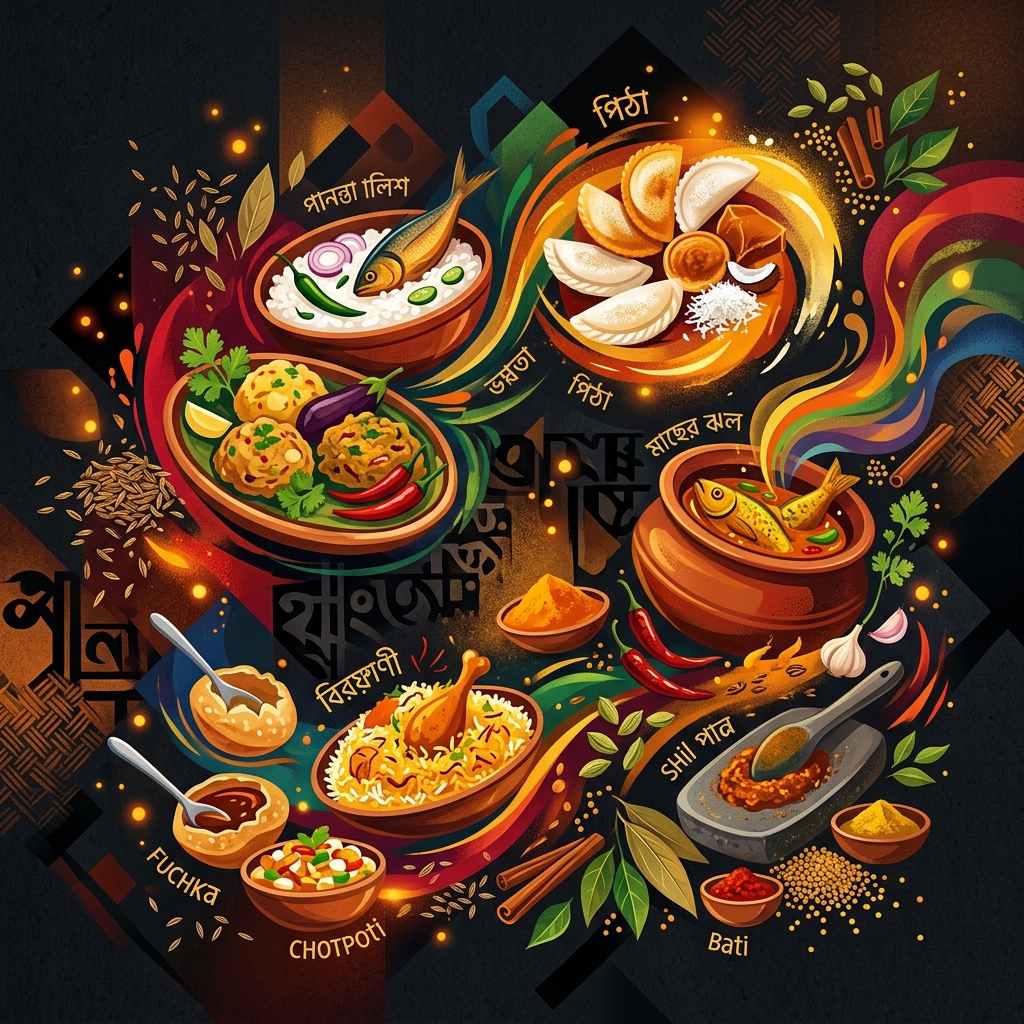
Shingara (samosa-like, but different — the filling is usually spiced mashed potato and sometimes lentil, the pastry is slightly different): everywhere, cheap, good at tea stalls.
Jhalmuri: puffed rice tossed with mustard oil, chopped onion, green chilli, cucumber, coriander, and assorted spices. Eaten from a paper cone, bought from jhalmuri sellers who mix it in a huge bowl with theatrical speed. One of the best cheap snacks on earth.
Chotpoti: boiled chickpeas and potatoes with a tamarind-based sauce, chopped onion, coriander, and sometimes egg. A Dhaka street staple.
Fuchka (known as golgappa in India): hollow fried shells filled with spiced tamarind water and chickpeas. The spiced water here is often significantly more sour and intense than the Indian version.
Biryani: In Old Dhaka in particular, biryani is a street food eaten from counters rather than a restaurant dish. Kacchi biryani (where raw meat is cooked layered with the rice) is the Old Dhaka specialty and is different from the biryanis you get elsewhere — the fat from the meat seasons the entire rice, and the result is richer and more intensely flavoured.
Tea: The Constant
Bangladeshis drink enormous quantities of tea. "Chaa" (from the same root as chai, cha, tea) is drunk at all hours — morning, afternoon, after meals, during work breaks, whenever there's a pause in the day. The standard preparation is strong black tea brewed with milk and sugar together, then strained into glasses. It's not subtle. It's exactly what it needs to be at 7am or 3pm.
The tea stall (chaa-er dokan) is a social institution. These are tiny operations — sometimes literally a man with a gas burner and a rack of glasses — that anchor street corners and local neighbourhoods. You stop, you drink tea, you talk, you go.
What to Try First as a Visitor
If I had to give a single itinerary for eating in Bangladesh:
Day 1 in Dhaka: Breakfast paratha and egg from a street stall. Lunch: dal-bhat-mach at a local restaurant. Evening: chotpoti or fuchka from a street vendor.
Day 2: Old Dhaka. Kacchi biryani from one of the old establishments. Borhani (yogurt drink, savoury and spiced) to go with it. Sweet from a mithai shop.
If in season: hilsa in any form, anywhere.
If in Rajshahi: local mishti (sweets), muri in the morning, and whatever the seasonal vegetable is at the market.
The food is straightforward in its foundations — rice, fish, dal, mustard, chilli — and very deep in its variations. You could eat Bangladeshi food for a month and not repeat a dish.