Bangladesh in 2020: A Country Moving Faster Than Anyone Expected
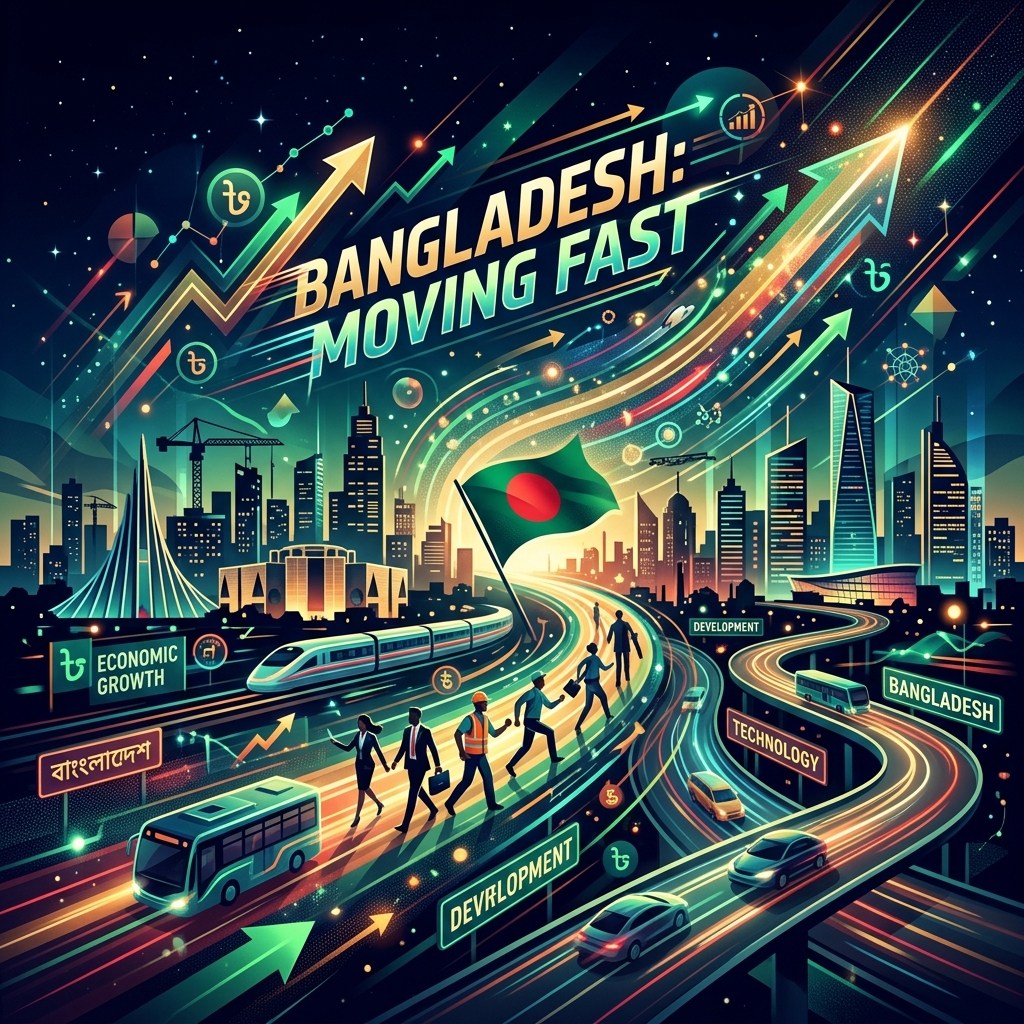
From the outside, Bangladesh is often described as a developing country. From the inside, it's a country that's been changing faster than that label suggests.
By the beginning of 2020, before the world became about something else entirely, Bangladesh was in the middle of something it had been in the middle of for about a decade: rapid, uneven, somewhat chaotic economic development that was producing visible results while generating new sets of problems.
I had been living in or around Dhaka for most of my undergraduate years. The city I was living in by early 2020 was measurably different from the city I had arrived in in 2016 — more flyovers, metro rail under construction, more high-rise apartments, more ride-sharing apps, more international fast food chains, higher costs, worse traffic somehow, more visible wealth at the top and a much larger urban middle class than four years earlier.
Here's what it felt like to be there.
The Economy That Surprised Everyone
Bangladesh's economic growth story is one of those things that development economists write about when they want to complicate the simple narratives. A country that was described as a "basket case" by Henry Kissinger in 1971 has sustained 6–8% annual GDP growth for much of the past two decades. Poverty rates have fallen dramatically — the percentage of people living below the national poverty line went from over 40% in 2005 to around 20% by 2019. Life expectancy has increased. Child mortality has fallen. Female education enrolment has exceeded male enrolment for decades.
The garment industry is the engine of this. Bangladesh is the world's second-largest apparel exporter after China, and the garment sector employs roughly 4 million people, the vast majority of them women. The remittances sent by Bangladeshis working abroad — in the Middle East, in Malaysia, in Europe and the US — are the other major pillar.
This is not a glamorous development story. It's built on low-wage labour in difficult conditions, on remittance workers doing hard jobs far from their families, on factory buildings that have sometimes collapsed with catastrophic loss of life (the Rana Plaza disaster in 2013 killed over 1,100 people and remains the worst garment industry disaster in history). The development is real and the costs are real simultaneously.
What Changed in Four Years
Comparing 2016 Dhaka to 2020 Dhaka:
The metro rail: The Dhaka Metro Rail (MRT Line 6) was under construction through most of this period, with above-ground infrastructure visibly taking shape. Traffic disruption from construction was severe. The line eventually opened in sections after 2022, but the promise of it was already reshaping how people thought about Dhaka's mobility — the first mass rapid transit in Bangladesh's history.
Digital payments and mobile banking: By 2020, Bkash (mobile financial services, a bKash joint venture) had more registered accounts than any conventional bank in Bangladesh. People paid for everything from utilities to street food using mobile money. Ride-sharing apps were firmly embedded in urban transportation. The shift from cash to digital payments for everyday transactions happened faster in Bangladesh than in many far wealthier countries.
Garment sector automation and pressure: The RMG (ready-made garment) sector was under increasing pressure from automation and from brands moving some sourcing to other countries. The sector was adapting but the adjustment was not painless.
Social media and political discourse: Facebook was ubiquitous in Bangladesh by 2020 in a way that's hard to overstate. Political news, rumours, community organisation, and commerce all ran heavily on Facebook. The implications for information quality and political discourse were similar to everywhere else where this happened — some genuine democratisation of information access alongside the problems of unmoderated misinformation and harassment.
The Rural-Urban Migration
The thing that strikes you most in Dhaka is that most of the people in it are not from Dhaka. The city's current residents are largely first or second generation migrants from the rural districts — people who came for the garment factories, for construction work, for domestic service, for the expanding retail and service sector, for the universities.
Rural Bangladesh in 2020 was different from rural Bangladesh in 2000. Mobile phone penetration in rural areas was high — not smartphones for everyone, but basic phones with voice and SMS, and increasingly smartphone access through shared devices and cheaper handsets. Electricity reach had expanded significantly through rural electrification programmes. Roads had improved in many areas, reducing the isolation of rural communities.
But the structural economic opportunity gap between Dhaka and everywhere else remained significant. Young people from rural backgrounds who had education and ambition came to Dhaka because Dhaka was where the jobs that matched those qualities existed. The city absorbed them, not always gracefully, and the cycle continued.
What Wasn't Changing Fast Enough
The infrastructure lag: Dhaka's roads, water, power, and waste infrastructure were being built and expanded but could not keep pace with the rate of urban growth. The flooding that hits Dhaka after heavy monsoon rain is not an act of God — it's the predictable result of inadequate drainage infrastructure in a city that paved over its natural water retention areas (the khals and wetlands that historically handled the water) without providing adequate alternatives.
Air quality in Dhaka was consistently among the worst of any major city in the world in the monitoring that existed. A combination of construction dust, vehicle emissions (many of them diesel and poorly maintained), brick kilns operating on the city's outskirts, and the general industrial pollution of a rapidly industrialising country. On bad days, the sky was visibly brown.
The political situation: Bangladesh has had one-party dominance for much of the past decade, with the Awami League government winning successive elections in circumstances that opposition parties and international observers described as problematic. The civil society and political opposition space was constrained. Corruption remained a significant structural problem despite anti-corruption programmes. These are real limitations on the development story that the GDP growth numbers don't capture.
The Generation Coming Up
The most striking thing about being in Bangladesh in this period was the generation of young people — 20s and early 30s — who were moving through the tech sector, the NGO sector, the business world, and the startup ecosystem. Better educated than their parents, more exposed to international standards through the internet and through diaspora connections, more aware of what Bangladesh could become because they could see comparable countries that had developed further.
These were people who were not waiting for the government to solve things. The freelancing economy they built was largely self-organised. The startups they were launching were addressing real local problems — last-mile logistics, digital financial services, ed-tech, health-tech — with approaches that didn't assume the institutional infrastructure would be there.
There's a pragmatic adaptability in how young Bangladeshis in this period approached work and life that comes from living in a place where things often don't work as they should. You develop workarounds. You find the paths around the obstacles. You build what you need when what you need isn't there.
Looking back from some distance, it's clear that this generation was building the foundations of something. What that something becomes over the next decade will depend on a lot of factors that were uncertain in 2020 and remain uncertain. But the human capital — the people — was there.
Before Everything Changed
The first COVID cases in Bangladesh were reported in March 2020. Within weeks, the country was in lockdown, the garment factories were facing mass order cancellations, and the economic gains of the previous decade were under threat in ways that nobody had planned for.
What came after is a different story. But the Bangladesh of early 2020 — moving fast, building unevenly, carrying real contradictions, producing a generation with real ambition — was worth recording.
Some of it was genuinely encouraging. Some of it was the familiar story of a country where growth creates wealth faster than it creates the institutions needed to distribute and sustain it. All of it was more complicated than any simple characterisation — "basket case" or "development miracle" — could capture.
The truth, as usual, was somewhere in the middle and more interesting than either.