RAG vs Fine-Tuning: How to Choose the Right Approach for Your LLM Application
Both approaches make LLMs more useful. They solve different problems. Here's when to use which.
When you're building an LLM-powered application and the base model doesn't know enough about your domain, you have two primary options: retrieval-augmented generation (RAG) or fine-tuning. They're often discussed as alternatives. They're not — they solve different problems. Understanding the distinction saves you weeks of wasted compute.
The Core Difference
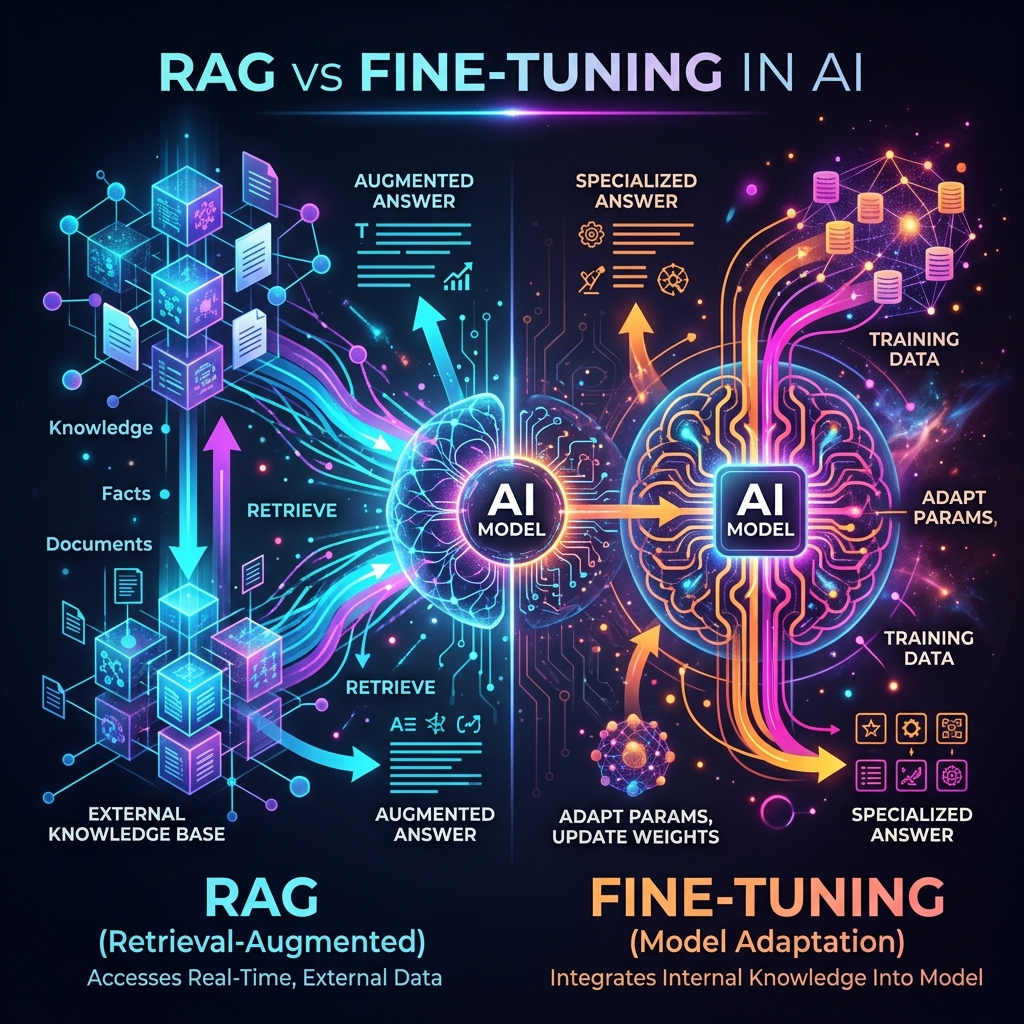
RAG gives the model information at inference time. You retrieve relevant documents, stuff them into the context window, and let the model reason over them.
Fine-tuning changes the model's weights. You train the model on your data so the knowledge becomes part of the model itself.
The analogy: RAG is like giving someone a cheat sheet before an exam. Fine-tuning is like making them study the subject for months. The cheat sheet is faster, cheaper, and always up to date. The studying creates deeper, more reliable expertise — but it's expensive and the knowledge can go stale.
When RAG Is the Right Choice
RAG is appropriate when:
Your knowledge base changes frequently. Company documentation, product catalogues, support articles, legal databases — these update constantly. With RAG, you update the vector database and the model immediately has access to new information. With fine-tuning, you'd need to retrain every time your knowledge changes, which is expensive and slow.
You need to cite sources. RAG retrieves specific documents that informed the answer, so you can show users exactly where information came from. Fine-tuned models have no equivalent — the knowledge is baked into weights with no traceability.
You have a large body of information that exceeds what you can reasonably fine-tune on. Entire document libraries, codebases with thousands of files, database schemas — these are better handled by retrieval.
You're prototyping or need to move fast. A working RAG pipeline can be running in hours. Fine-tuning a model that performs well takes days to weeks of iteration.
Cost matters. RAG adds latency and inference cost (larger context windows cost more), but it has no training cost. Fine-tuning requires GPU time for training, which adds up fast.
When Fine-Tuning Is the Right Choice
Fine-tuning is appropriate when:
You need a specific output format or style that's hard to prompt. If you want the model to always return structured JSON with specific fields, or write in a particular voice, or follow domain-specific patterns — fine-tuning reliably internalises these behaviours in a way that few-shot prompting often doesn't.
You're working in a specialised domain where the base model lacks fundamental knowledge. Medical diagnosis from imaging reports, legal brief writing, niche programming languages, proprietary terminology — these are cases where the base model's training data was sparse and the model needs new foundational knowledge, not just document access.
Latency is critical. RAG adds latency: you need to embed the query, search the vector database, retrieve documents, build a context, and then call the LLM with a much larger prompt. Fine-tuned models can answer directly with no retrieval step.
You're dealing with sensitive data you can't send to a cloud API. If your documents can't leave your infrastructure (PII, medical records, legal materials), you might need to fine-tune an open-source model locally rather than using a RAG pipeline over a cloud LLM.
You need to change model behaviour, not just knowledge. Fine-tuning can change how a model reasons, not just what it knows. RLHF (reinforcement learning from human feedback) is a form of fine-tuning that shaped ChatGPT's helpfulness. If you want the model to be more conservative, more creative, or follow a specific reasoning process, fine-tuning is the lever.
The Architecture of a RAG Pipeline
A production RAG system has more moving parts than the basic description suggests:
User query
    ↓
Query preprocessing (intent classification, query rewriting)
    ↓
Embedding model (convert query to vector)
    ↓
Vector database search (find semantically similar documents)
    ↓
Reranker (score retrieved chunks for actual relevance)
    ↓
Context assembly (combine retrieved chunks with conversation history)
    ↓
LLM call with assembled context
    ↓
Response with source citations
The weakest links in most RAG implementations are:
- Chunking strategy: How you split documents into chunks dramatically affects retrieval quality
- Missing reranking: Raw vector search returns similar text, not necessarily relevant text — a reranker (cross-encoder) substantially improves precision
- Query understanding: A user asking "what's the return policy?" might need to retrieve from multiple sections of a document
The Architecture of a Fine-Tuning Pipeline
Base model + training data
    ↓
Data preparation (formatting, deduplication, quality filtering)
    ↓
Training run (full fine-tune, LoRA, or QLoRA depending on resources)
    ↓
Evaluation on held-out test set
    ↓
Iteration (adjust data, hyperparameters, training duration)
    ↓
Deployed fine-tuned model
LoRA (Low-Rank Adaptation) and QLoRA (quantised LoRA) have made fine-tuning much more accessible — you can fine-tune a 7B parameter model on a single consumer GPU in hours, rather than needing expensive clusters. But quality still requires careful attention to training data quality and evaluation.
Combining Both
The most powerful production systems often use both. You fine-tune the model for format, domain style, and reasoning patterns — then use RAG to give it access to current, specific information at inference time.
Example: A customer support system might fine-tune a model on thousands of high-quality support interactions to make it sound like an expert in the company's domain, then use RAG to retrieve current product documentation and account-specific context at query time.
A Decision Framework
| Question | Points to RAG | Points to Fine-Tuning |
|---|---|---|
| Does the knowledge change frequently? | ✓ | |
| Do you need source attribution? | ✓ | |
| Is training data volume small (<10k examples)? | ✓ | |
| Is inference latency critical? | ✓ | |
| Is the output format highly specific? | ✓ | |
| Is the knowledge domain truly specialised? | ✓ | |
| Does sensitive data need to stay local? | ✓ |
If you're genuinely unsure, start with RAG. It's faster, cheaper, and gives you working results quickly. You can layer in fine-tuning later if the performance ceiling isn't high enough.
The Common Mistake
The most common mistake I see: spending weeks fine-tuning a model when the problem was actually about retrieval quality or prompt engineering.
Before committing to fine-tuning, run these experiments:
- Can better prompting (chain-of-thought, few-shot examples, clearer instructions) get you where you need to go?
- Can improved chunking and retrieval in your RAG pipeline close the gap?
- Is the model failing because it lacks knowledge, or because it lacks the right behaviour?
Fine-tuning is powerful. It's also expensive, slow, and requires ongoing maintenance. Make sure you actually need it before you invest.