AI in Travel Tech: How Machine Learning Is Reshaping OTAs, Pricing and the Booking Experience
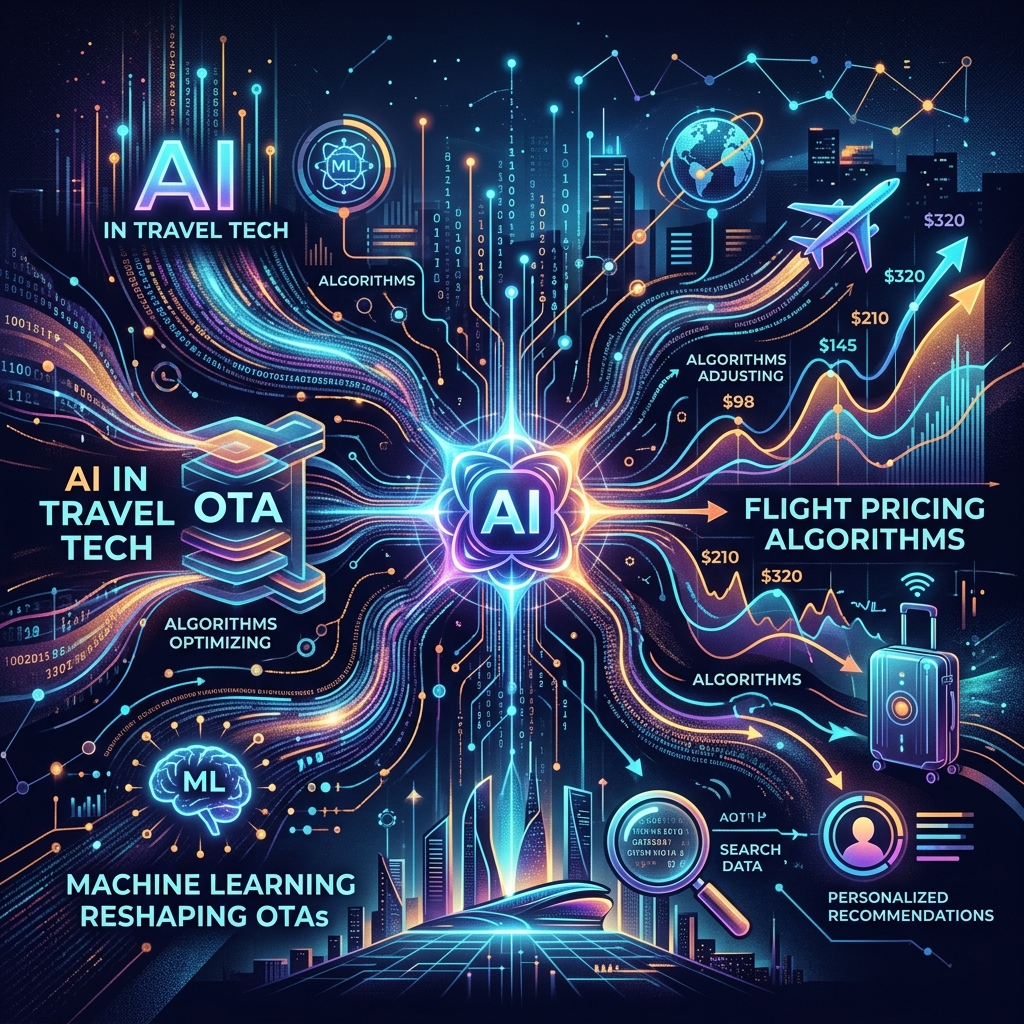
Airlines and OTAs have been using machine learning for decades. Here's where it actually runs today and where it's heading.
Travel technology companies have been using machine learning since before the term became fashionable. Airline revenue management systems in the 1990s were early examples of ML applied at scale. Today the applications have proliferated across the entire travel stack — from the moment you search to the moment you land.
Here's where AI is actually running in travel tech today, what the meaningful applications are, and what's genuinely new versus what's just rebadging old techniques.
Revenue Management: The Original Travel AI
Airline revenue management is the oldest and most mature AI application in travel. The problem is elegant in theory and brutal in practice: given a finite set of seats on a flight, with variable demand from different customer segments, how do you set prices to maximise revenue?
Modern revenue management systems use:
- Demand forecasting: Statistical models predicting how many passengers will book at various price points, using historical data by route, seasonality, day of week, time to departure, and competitive pricing
- Price optimisation: Continuous adjustment of fare class availability based on real-time booking pace vs forecast
- O&D (origin-destination) control: Managing seat allocation not just by flight leg but by origin-destination pairs on connecting itineraries
- Competitive response models: Monitoring competitor prices and automatically adjusting availability
These systems run continuously, re-optimising prices every few minutes. The difference between a well-calibrated RM system and a poorly calibrated one can be millions of euros in annual revenue on a moderately sized airline.
What's new with LLMs: Revenue management itself hasn't been transformed by generative AI — it's a structured optimisation problem where classical ML and operations research techniques work well. What's changing is the analyst workflow: natural language interfaces for querying RM systems, generating forecast explanations, and flagging unusual booking patterns.
Search Ranking and Personalisation
When you search for "London to Tokyo" on an OTA, the results that appear are not presented in a neutral or random order. They're ranked by a model trained to maximise some combination of booking conversion, revenue, and user satisfaction.
OTA search ranking models consider:
- Price competitiveness: How does this offer compare to alternatives?
- Historical conversion: For users like this, in this context, what has previously led to bookings?
- Supplier quality signals: Review scores, cancellation rates, service reliability
- Margin: Some OTAs weight higher-margin options in ranking, within limits
- User history: Has this user booked this carrier or property before? Did they express preferences?
Personalisation goes further: showing different results to different users based on inferred preferences. A user who always books non-stop flights in business class gets a different default ranking than a budget traveller. This runs on embedding models that represent user preference as a vector, then rank options by similarity to that preference vector.
Dynamic Packaging
Traditional package holidays (flight + hotel) were pre-assembled by tour operators. Dynamic packaging assembles combinations on the fly at time of search.
The AI challenge in dynamic packaging is selecting which combinations to show. With thousands of hotels and dozens of flight options for a given destination, the naive approach (show all combinations) is computationally intractable. ML models predict which combinations are most likely to convert for a given user and surface those.
Upselling and cross-selling models: After flight booking, models predict the probability that a given user will book a hotel, car rental, or travel insurance. The ranking and timing of these offers is optimised by ML systems trained on historical purchase sequences.
Fraud Detection
Online travel is a major target for payment fraud, account takeover, and loyalty programme fraud. Fraud detection in travel uses:
Transaction scoring: Real-time models scoring each booking for fraud likelihood. Features include card velocity (how many cards used in a time window), IP geolocation vs billing address, booking patterns (someone booking flights for 10 people under 60 minutes is suspicious), and device fingerprint.
Loyalty fraud: Loyalty points are liquid assets. Accounts with unusual point accumulation or redemption patterns are flagged by ML anomaly detection.
Identity document verification: Computer vision models for verifying that uploaded ID documents are genuine and match the traveller claiming them.
Natural Language Search and LLM-Powered Assistants
This is where the generative AI wave has had the most direct impact on the user-facing experience:
Conversational search: Instead of filling in origin, destination, dates, and passenger count, users can describe a trip: "I want to go somewhere warm in Europe in January, budget around €800 all-in for a week." Systems that can parse this intent and return relevant options are genuinely useful.
Itinerary planning: LLM-powered assistants can take a destination and a duration and generate a day-by-day itinerary, suggest attractions, estimate costs, and adapt based on user feedback. Google's AI Overviews, Booking.com's AI assistant, and various startups are all building in this space.
Customer service automation: The highest-volume customer service queries in travel are flight status, booking changes, and baggage queries — all well-suited to automation. LLM-powered agents that can look up bookings, check policies, and execute changes are reducing call centre load.
The genuine challenge in travel AI assistants is grounding: the LLM needs to have access to live inventory, real policies, current prices, and booking state. An LLM that confidently books a non-existent flight or quotes an incorrect cancellation policy is worse than no assistant at all. The architecture that works is LLM + structured tool calls to live systems, not LLM answering from training data.
Hotel and Accommodation Pricing
The dynamic pricing problem in hotels is similar to airlines but has different constraints:
- Hotel rooms don't expire the same way flight seats do (unsold rooms don't fly away empty)
- Demand signals include events, conferences, local occupancy rate, competitor availability
- Review score impacts conversion and willingness-to-pay
ML-powered revenue management for hotels is well-established (IDeaS, Duetto, RateGain are specialist vendors). What's newer is AI-assisted pricing for smaller properties — individual vacation rentals and boutique hotels — that previously couldn't afford specialist RM systems.
Tools like PriceLabs and Beyond Pricing bring ML-powered dynamic pricing to Airbnb and VRBO hosts. The market rate for an apartment in Lisbon during a major tech conference week is meaningfully different from the same apartment the week after — and ML models can capture this signal.
What's Actually New vs Rebadged
Not everything labelled "AI" in travel is new. Some scepticism is warranted:
Not new (but often newly labelled as AI):
- Rule-based chatbots → still rule-based, now called "AI assistant"
- Statistical demand forecasting → still ARIMA/ETS models, now called "AI forecasting"
- Simple recommendation ("people who booked X also booked Y") → collaborative filtering, decades old
Genuinely new or significantly improved by recent AI advances:
- Natural language understanding for unstructured travel intent
- Image-based search (searching hotels by the aesthetic of room photos)
- Real-time multi-modal customer service (voice + text + booking state)
- Document understanding (parsing airline tickets, hotel vouchers from PDFs or images)
- Sentiment analysis at scale on reviews for supply quality monitoring
The Near-Term Trajectory
The 2–5 year horizon for AI in travel:
Agentic booking: AI agents that can complete end-to-end travel booking on behalf of a user — searching, comparing, selecting, booking, and managing changes — without the user manually clicking through each step. The foundation (LLMs with tool use) is in place. The challenge is reliability and the consequential nature of errors.
Predictive customer service: Models that predict service issues before they happen. An airline knowing (from flight delay data, rebooking patterns, and weather models) that a specific connecting itinerary is likely to fail, and proactively rebooking the passenger before they're stranded.
Personalised pricing at scale: Moving beyond segment-based pricing to genuinely individual offers, legally and commercially constrained by regulations against price discrimination.
Disruption management automation: When irregular operations (IROPS) events happen — cancellations, major delays — the rebooking of thousands of passengers is today largely manual. AI systems that can automatically re-accommodate passengers at scale, within policy constraints, and in priority order represent a significant operational improvement.
Travel is one of the industries where AI has the clearest path to value — the data is rich, the optimisation problems are well-defined, and the cost of getting things wrong (stranded passengers, missed connections) is visible and measurable. The gap between current capability and the theoretical ceiling is still wide.