Europe for First-Timers: What Actually Matters
13 things I wish someone had told me before my first trip to Europe — from a Bangladeshi who ended up staying.
I came to Europe for the first time as a visitor. Then I came back. Then I stayed.
So when people ask me about travelling Europe for the first time, I have a specific perspective — not the perspective of someone who grew up here and takes the trains for granted, but someone who had to figure it all out from scratch. These are the things that actually made a difference.
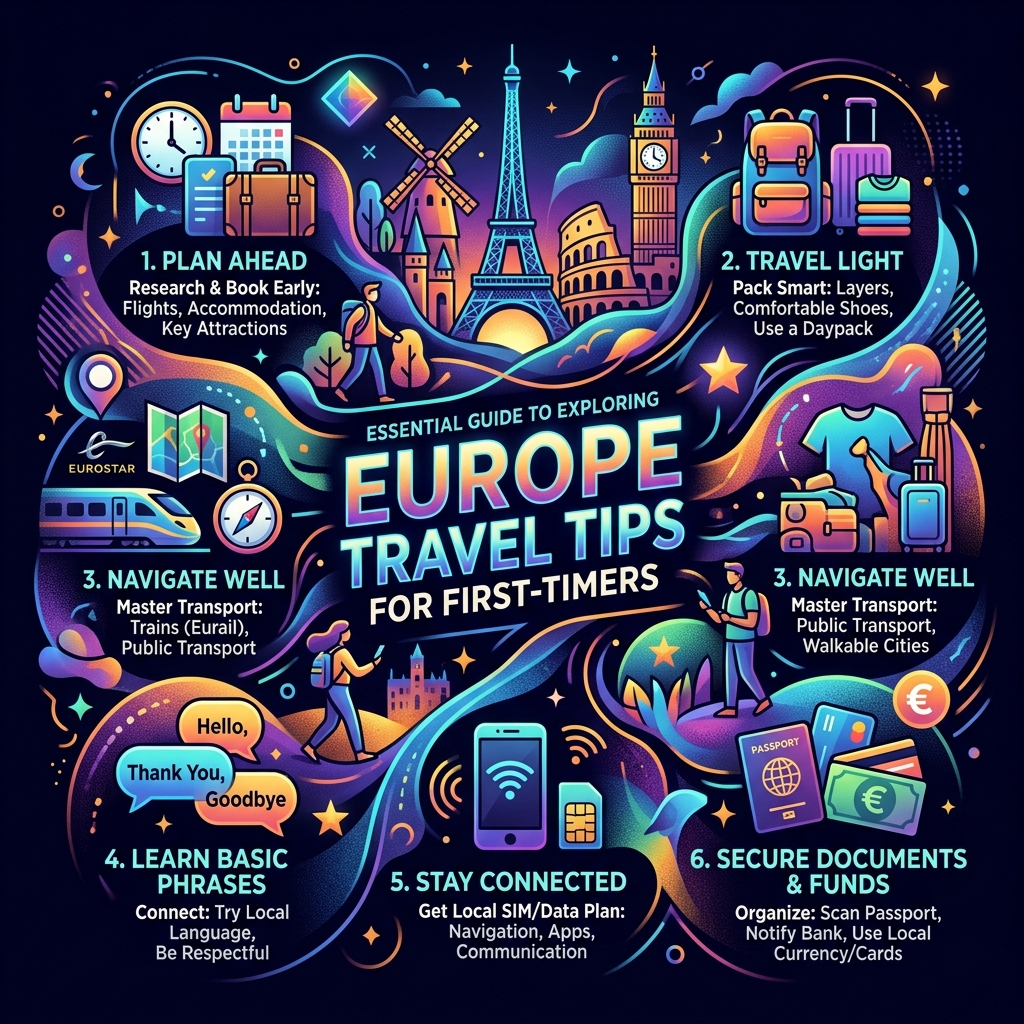
1. Book the big things early, leave room for everything else
Flights and accommodation in popular cities during peak season — book these early. Hotels in Paris, Amsterdam, and Barcelona fill up and prices spike badly. But don't over-plan the days themselves. Europe rewards wandering. Some of the best things I've found were streets I walked down by accident.
Leave at least a third of your itinerary unplanned.
2. Pack less than you think you need
European cities are old. That means cobblestones, stairs, narrow corridors, and no elevator in your fourth-floor hotel. A big rolling suitcase becomes a problem very quickly.
One carry-on bag. That's it. You can buy anything you forgot once you're there, and laundromats exist everywhere.
3. Learn ten words in the local language
Not fluency. Ten words: hello, please, thank you, excuse me, do you speak English, where is, how much, one coffee, sorry, good night.
The effort is noticed. It changes how people treat you. In France especially, attempting French — even badly — opens doors that staying in English doesn't.
4. Public transport is the right way to move
Don't rent a car for your first European trip unless you're specifically doing rural areas or road trips. City centres are not built for cars. Parking is expensive, driving is stressful, and the public transport is genuinely excellent in most Western European countries.
In most cities: buy a multi-day transit pass on your first day. It covers metro, tram and bus, it's cheaper than individual tickets, and it removes the friction of figuring out fares every time.
5. Trains between cities are often better than flights
For journeys under 4-5 hours, the train beats flying once you factor in airport time, security, baggage claim, and getting from the airport to the city centre. You arrive at a central station, in the middle of the city, without the stress.
Frankfurt to Paris: 3h40 by high-speed train. City centre to city centre. Amsterdam to Brussels: under 2 hours. London to Paris via Eurostar: 2h15.
Book train tickets a few weeks ahead for the best prices. Rail Europe and the national rail websites (SNCF, Deutsche Bahn, Renfe) are where to look.
6. Tipping is different everywhere — and that's fine
This confuses a lot of visitors from countries with mandatory tipping culture (and visitors from countries with no tipping culture).
The short version: tipping is appreciated but rarely expected the way it is in the US. In Germany, rounding up the bill or leaving a euro or two is normal. In France, a small tip for good service is kind but not obligatory. In some countries — Japan if you ever go there, though that's not Europe — tipping can actually be considered rude.
Ask locally if you're unsure. Nobody will be offended by the question.
7. Dress codes at religious sites are real
Many of Europe's most visited buildings are active churches, mosques, and synagogues. They have dress codes. Shoulders covered, knees covered. Some provide wraps at the entrance; many don't.
If you're planning to visit the Sagrada Família, the Vatican, Sacré-Cœur, any mosque in the Balkans, or similar sites — check the dress code before you go, not after you've queued for an hour.
8. Get a good anti-theft bag
Pickpocketing in tourist areas of major European cities is a real and common problem. Not dramatic robbery — just practiced, quick theft in crowds.
The targets are obvious tourist bags, open backpacks, phones left on café tables, and back pockets. An anti-theft bag (hidden zips, slash-resistant straps) and a habit of keeping your phone in a front pocket removes most of the risk.
9. Get travel insurance — not travel health insurance, travel insurance
Most people think about this wrong. They get travel health insurance because that sounds important. What you actually need is comprehensive travel insurance that covers:
- Medical expenses (yes)
- Trip cancellation
- Delayed or lost luggage
- Flight cancellations
I've had delayed luggage twice and a flight cancellation once. The insurance paid each time. It costs maybe €30-50 for a two-week trip. Get it.
10. Register with your embassy if you're staying a while
If you're from outside Europe and you're staying more than a couple of weeks, register with your home country's embassy or consulate in the country you're visiting. Most countries have an online system for this.
It sounds bureaucratic and unnecessary until something goes wrong — a natural disaster, a civil emergency, a lost passport. Your embassy can't help you if they don't know you're there.
11. Eat where locals eat — which usually means walking away from the main square
The restaurant with the laminated multi-language menu and the photos of every dish right next to the cathedral? It's fine. It's also priced for people who won't come back.
Walk two or three streets away from the obvious tourist zone. Look for places with handwritten menus, where you hear the local language being spoken, where the staff aren't standing outside trying to pull you in. Eat lunch there. It'll be better and half the price.
12. Free things in Europe are genuinely good
Many of the best museums in Europe are free — or free on certain days. The British Museum in London: free. The Rijksmuseum in Amsterdam: not free, but the National Gallery equivalents in many cities are. National parks, beaches, most historic town centres — free to walk around.
Research free museum days before you go. In many cities, the first Sunday of the month makes major museums free. Some cities have tourist passes that cover public transport and museum entry together, which can save significant money.
13. Let yourself get lost on purpose
This is the actual tip. Everything above is useful. But the best experiences I've had in Europe — the courtyard I found in Lisbon, the late-night café in Vienna, the canal path in Bruges that wasn't in any guide — came from having no plan and following what seemed interesting.
Europe is dense with things worth seeing that nobody wrote a blog post about. Give yourself time to find some of them.
I've been living in Frankfurt for a few years now and I travel around Europe regularly. If you have specific questions about a destination, a route, or what to do in Frankfurt specifically — drop me a message. Happy to help.