AEO: Answer Engine Optimization and Why It's Becoming More Important Than Traditional SEO
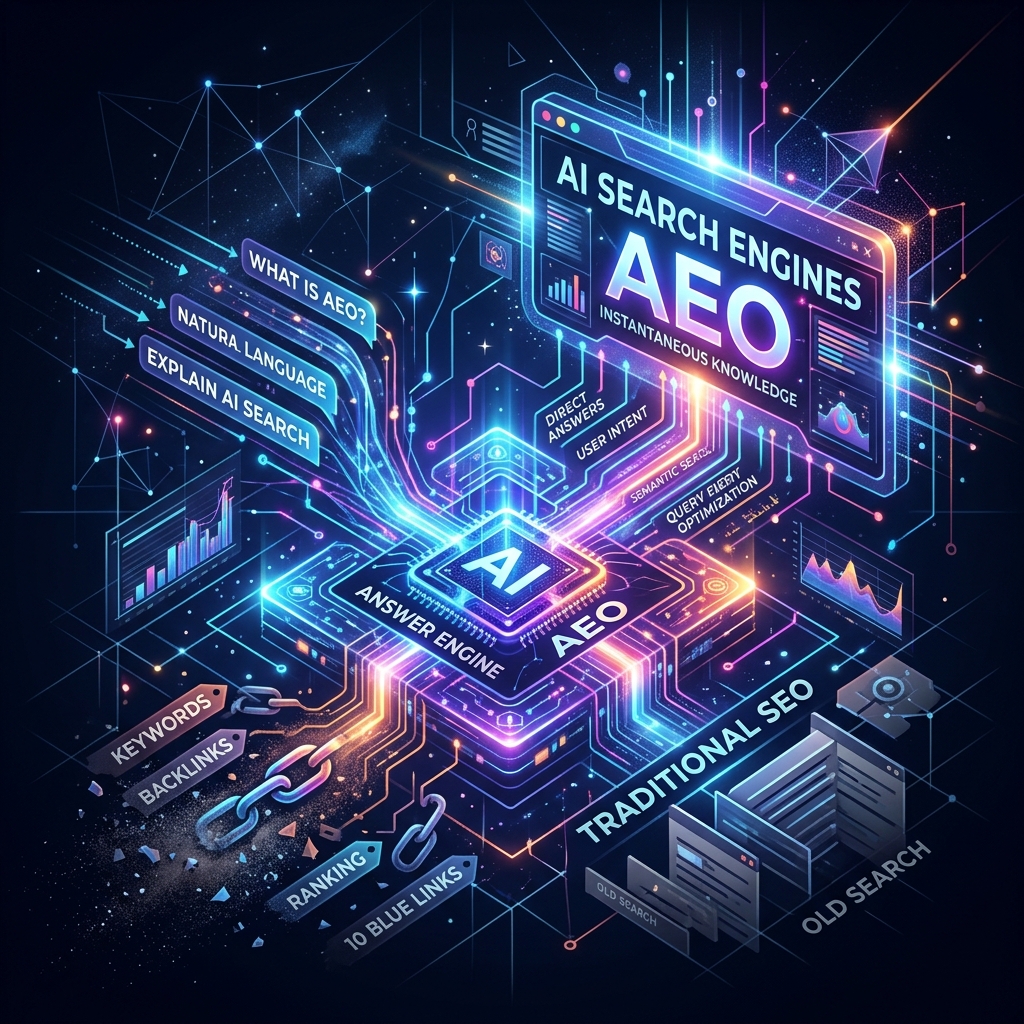
When AI answers a question instead of listing 10 links, ranking #1 in Google matters less. AEO is how you get cited instead of skipped.
Something shifted in early 2023. ChatGPT had already passed 100 million users. Bing integrated GPT-4 into search. Google launched its own AI Overviews. Perplexity was growing. The behaviour that had been standard for 25 years — type a query, get a list of links, click the most promising one — was being replaced, for a growing number of queries, by a single synthesised answer.
If you've been focused purely on traditional SEO — rankings, traffic, backlinks — you need to start thinking about what happens when the answer to a query is delivered directly rather than as a ranked list of URLs.
That's what Answer Engine Optimization (AEO) is about.
What's Actually Changing
A traditional search engine is a navigation tool. It doesn't answer questions directly — it helps you find the page that answers the question. Its value to you is the traffic it sends.
An answer engine (ChatGPT, Perplexity, Bing AI, Google AI Overviews) answers the question directly. It may cite sources. It may link to pages. But the user often gets what they need without clicking anything.
For informational queries — "how does compound interest work", "what documents do I need for a UK visa", "compare Stripe vs PayPal" — answer engines now frequently provide the answer directly. The click to your page may never happen.
This doesn't mean SEO is dead. For transactional queries ("buy running shoes", "book a hotel in Frankfurt"), navigational queries ("GitHub login"), and queries where the user wants a specific source or experience, traditional search and clicks remain. But the proportion of zero-click informational searches is growing, and AEO is the response to that shift.
How Answer Engines Work
Large language model-based answer engines (Perplexity, ChatGPT with web browsing, Bing AI) work roughly like this:
- User submits a query
- The system retrieves potentially relevant web pages (via search index or real-time crawling)
- The LLM reads those pages and synthesises an answer
- The answer is returned, often with citations to the sources used
The sources cited are typically pages that are:
- Clearly written and directly answering the specific question
- From authoritative/trusted domains
- Well-structured and easy to parse (headings, concise paragraphs, clear answers near the top)
- Technically accessible (fast, crawlable, properly indexed)
If this sounds similar to traditional SEO signals — it is. AEO is not a complete break from SEO. It builds on the same foundations and adds specific optimisations for how AI systems consume content.
The Difference: Position vs Citation
Traditional SEO goal: rank as high as possible so users click your link.
AEO goal: be cited as a source in the AI's answer, and frame your content as the answer itself.
The metrics diverge:
- Traditional SEO success = ranking + clicks + sessions
- AEO success = citations + brand mentions in AI responses + traffic from users who want to go deeper
Ranking #3 for a keyword in traditional search sends meaningful traffic. Being cited as a source in a Perplexity answer for the same query might send less traffic but positions your brand as authoritative in an AI response that many users trust implicitly.
Specific AEO Tactics
Write to Directly Answer Questions
Answer engines look for content that directly states the answer to a question. Not three paragraphs of preamble and then the answer — the answer, then the context.
Structure: Question as heading → Direct concise answer → Supporting explanation → Examples → Related questions
This mirrors FAQ schema structure and is also what appears in Google's featured snippets. The discipline of direct answering serves both traditional SEO (featured snippets) and AEO (LLM citation).
Use Structured, Parseable Formatting
AI systems read HTML. Headings (H1–H4) signal the structure of information. Bullet points and numbered lists are easier to parse than dense prose. Tables communicate comparison data clearly.
Format your content so that a system reading it can extract the key information without needing to interpret long unstructured paragraphs.
Schema Markup for Semantic Clarity
Schema.org structured data tells AI systems (and Google's AI systems specifically) what type of content a page contains. FAQPage schema for Q&A content, Article schema for editorial content, HowTo schema for step-by-step guides — these help answer engines understand the content structure and are more likely to pull from structured, semantically labelled pages.
Establish Entity Authority
AI systems understand entities — named concepts, people, organisations, places — and their relationships. Building entity authority means:
- Having a clear, consistent identity across your site and across the web (Wikipedia page if relevant, Wikidata entry, Google Knowledge Panel, consistent NAP for businesses)
- Being mentioned alongside the relevant concepts in your space
- Having your brand, name, or domain appear in authoritative sources in your niche
When an AI is generating a response about, say, travel eSIM options for international travellers, it's more likely to cite and mention entities it has high-confidence knowledge about from its training data and crawled sources.
Create Genuinely Comprehensive Content
LLMs prefer synthesising from fewer, more comprehensive sources over many shallow ones. A single page that comprehensively covers a topic — answering the main question and the natural follow-up questions — is more likely to be a go-to citation than five thin pages that each cover one aspect.
This aligns with the topical authority approach in traditional SEO: covering a subject deeply rather than broadly.
Optimise for Perplexity Specifically
Perplexity.ai has become the most widely used dedicated AI answer engine and it has a distinct crawling behaviour — it actively crawls web pages in real time when answering queries. It also cites sources with links prominently.
Being indexed and cited by Perplexity requires:
- Your pages being crawlable (no robots.txt blocks for PerplexityBot)
- Your content being retrievable and well-formatted
- Your domain having enough authority to be included in retrieved results
Check your robots.txt to make sure PerplexityBot and other AI crawlers are permitted. The robots.txt on a well-configured site should explicitly allow: Googlebot, GPTBot, PerplexityBot, anthropic-ai, Claude-Web.
What AEO Doesn't Change
Brand and trust building still matter: If an AI cites you as a source, users who want to go deeper will click through. They may bookmark you. They may subscribe. The traffic quality from AEO citations may be higher than SEO traffic because the user has already been told you're authoritative.
Backlinks and domain authority still matter: Answer engines use the same quality signals traditional search uses to evaluate source credibility. High-authority domains with real backlinks are more likely to be cited.
Unique research and data still matter: AI systems can't generate original data or research. A page with original survey data, proprietary analysis, or unique findings gives the AI something it can only get from you.
The Near-Term Picture
AEO is not replacing SEO — they're complementary. The traditional search click is not disappearing; it's declining for a specific category of informational queries where AI summaries are highly effective.
The response isn't to abandon SEO and pivot to AEO. It's to extend your content strategy to explicitly serve both: content that ranks well in traditional search and that is optimally structured to be cited and synthesised by AI systems.
The content that does both is: genuinely comprehensive, directly answering questions, well-structured with headings and lists, schema-marked, from an authoritative domain, crawlable by AI bots.
If that sounds like good content practice — it is. AEO isn't a different discipline. It's the same discipline with AI systems as an additional audience.