Registering a UK Limited Company as a Non-Resident: The Complete Process
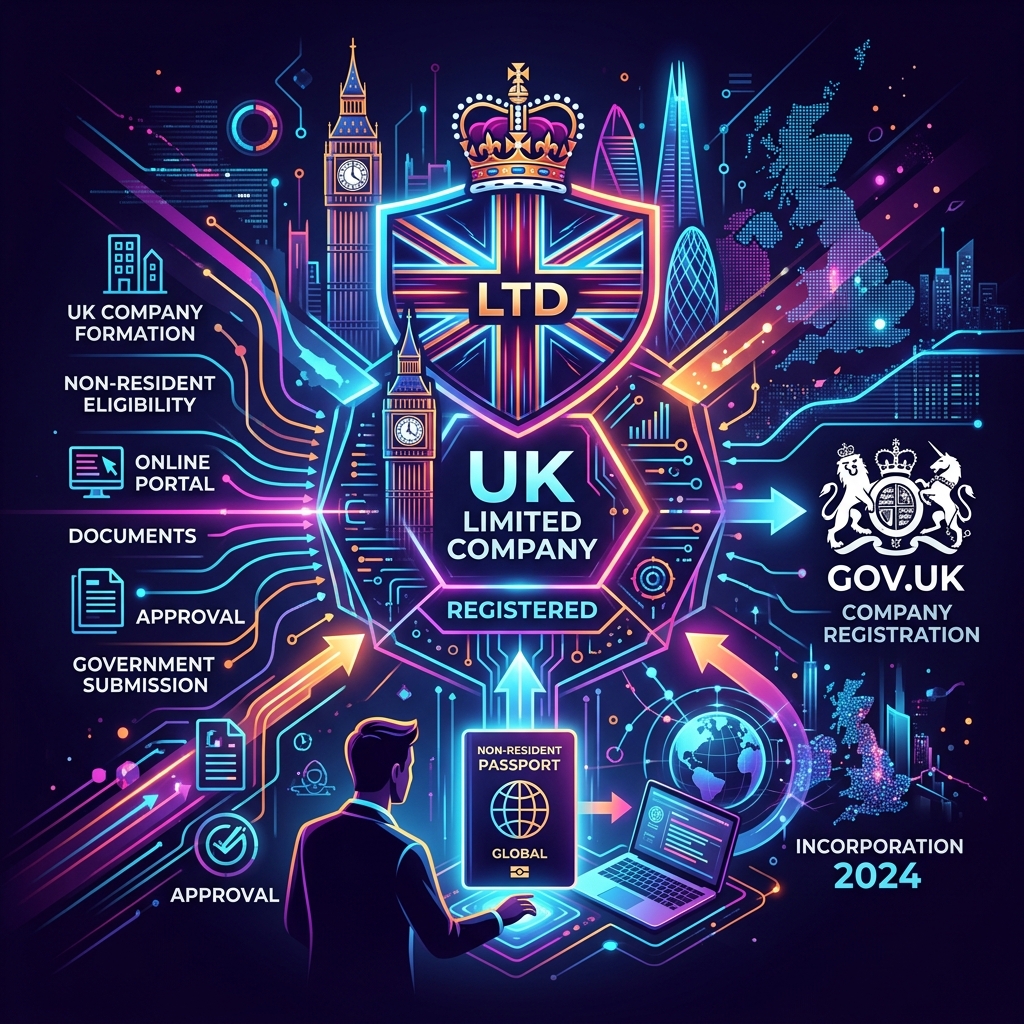
You don't need to live in the UK to own a UK company. Here's how the process actually works, from incorporation to your first bank account.
The United Kingdom has one of the most accessible business registration systems in the world for non-residents. You don't need to live in the UK, hold a UK visa, or even visit to incorporate a company at Companies House. The entire process can be done remotely, typically in 24 hours, and the costs are low.
That's the good news. The less-discussed part is what comes after incorporation — banking, taxation, compliance — which is where many founders discover the gap between "company registered" and "business operational."
This is the full picture.
Why a UK Limited Company
The UK Ltd (Private Limited Company) is a popular structure for non-resident founders for several reasons:
Credibility: A UK Ltd with a Companies House registration number is recognised globally. For B2B businesses, invoicing clients under a UK entity carries more weight than a company from many other jurisdictions.
Taxation: Corporation tax in the UK is levied on profits, not revenue. Rates in 2021 were 19% flat (this has since changed — check current rates). The UK has double tax treaties with over 130 countries, which matters for founders who might be tax resident elsewhere.
No residency requirement: Directors and shareholders can be non-residents. There's no requirement for a UK director, though some service providers prefer it.
Flexibility: A UK Ltd can hold foreign bank accounts, own intellectual property, receive revenue from anywhere, and pay dividends to shareholders in any country.
EU market access post-Brexit: Less of an advantage after 2020, but the UK still has bilateral trade agreements and is a major market in its own right.
Step 1: Choose a Company Name
Your company name must be unique and not too similar to an existing registered name. You can check availability at the Companies House name search tool.
Rules:
- Must end in "Limited" or "Ltd"
- Cannot be offensive or misleading
- Certain words require special permission ("Bank", "Royal", "University", etc.)
- The name is checked against the Companies House register, not trademark databases — you should separately check the UK Intellectual Property Office (IPO) if brand protection matters
Step 2: Prepare the Required Information
To incorporate, you'll need:
Registered office address: Must be a physical UK address (not a PO box). This is the official address where Companies House correspondence is sent and which appears on the public register. Most non-residents use a registered address service — these cost £50–150/year and forward mail. Popular providers: 1st Formations, The Formations Company, Quality Company Formations.
Director details: Full name, date of birth, nationality, and residential address (this is kept private but required). A company must have at least one director who is a natural person (not another company). Directors must be 16 or older and not be disqualified.
Shareholder details: Who owns the company and in what proportions. For a sole founder, you'd typically hold 100 ordinary shares of £1 nominal value each.
SIC code: Standard Industrial Classification code — a category describing what the company does. There are hundreds to choose from.
Memorandum and Articles of Association: The constitutional documents of the company. When forming through an agent or online, you'll typically use "model articles" (the standard template) which are fine for most purposes.
Step 3: Incorporate
The simplest route is through a formation agent (not directly through Companies House's own interface, which is slightly more cumbersome). Cost is typically £12–50 for the basic service.
Popular formation agents:
- 1st Formations — reliable, clear pricing, includes free registered address for the first year
- Quality Company Formations — similar offering
- Rapid Formations — 24-hour guaranteed processing
Alternatively, you can file directly on the Companies House website for £12. Same-day incorporation is available for an additional fee.
After submission, Companies House typically processes within 24 hours (often faster). You'll receive a Certificate of Incorporation with your company registration number (CRN) — this is the proof that your company exists.
Step 4: Register for Tax
Within 3 months of starting to trade, you must register your company for Corporation Tax with HMRC. This can be done online. You'll receive a Unique Taxpayer Reference (UTR) — keep this safe, you'll need it for everything tax-related.
If your revenue will exceed the VAT threshold (£85,000 in 2021), you must register for VAT. Below this threshold, registration is optional. For B2B businesses selling to VAT-registered UK customers, voluntary registration can be beneficial as you can reclaim input VAT.
If you're paying yourself as a director, you'll also need to set up PAYE through HMRC's employer system.
Step 5: Open a Business Bank Account
This is where most non-resident founders hit the biggest obstacle.
High-street UK banks (Barclays, HSBC, Lloyds, NatWest) are extraordinarily difficult to open accounts with as a non-resident director. They typically require an in-branch appointment in the UK, extensive KYC documentation, and often reject non-resident applications entirely.
The practical alternatives:
Wise Business: Excellent for international businesses. Provides UK account details (sort code and account number), can hold multiple currencies, and the transfer fees are transparent and low. Opens remotely with standard ID verification. The most common first choice for non-resident UK company founders.
Revolut Business: Similar offering. Good multi-currency support, easy signup, cards available.
Airwallex: Strong for businesses with significant cross-border payment volume. Better exchange rates at higher volumes.
Tide / Starling Bank: UK-based digital banks with simpler onboarding than high-street banks. Some accept non-resident directors. Worth trying.
Note: Wise and Revolut are not banks in the traditional sense — they're e-money institutions. For most operational purposes (receiving payments, making transfers, holding currency) this distinction doesn't matter. For getting a bank loan or certain regulated activities, you'd need a full banking licence holder.
Annual Compliance
Once incorporated, a UK Ltd has ongoing requirements:
Confirmation Statement: Filed annually with Companies House (used to be called Annual Return). Confirms that the information on the register is accurate. Cost £13 when filed online. Failure to file results in the company being struck off.
Annual Accounts: Must be filed with Companies House each year (deadline is 9 months after your accounting year end). For small companies, abbreviated accounts are sufficient. You'll likely need an accountant.
Corporation Tax Return: Filed with HMRC (deadline is 12 months after accounting year end, but tax is due within 9 months and 1 day). An accountant is strongly recommended.
PAYE/RTI: If paying salaries, real-time payroll reporting is required.
For a non-trading or dormant company, the requirements are simpler but still exist.
The Tax Residency Question
A crucial point that many non-resident founders miss: where a UK company is managed and controlled determines its tax residency. If you, as the director and decision-maker, are resident in another country and all the management decisions are made from there, HMRC may argue the company is tax resident in your country of residence — not in the UK.
This is the "central management and control" test. It doesn't mean you can't have a UK company from abroad — it means you should take advice on your specific situation, particularly if your home country has controlled foreign corporation (CFC) rules that might tax UK company profits in your hands.
This is complex territory. If you're building a real business (not just a holding structure), the management and control issue should be discussed with an accountant familiar with both UK and your home country tax law.
Cost Summary
| Item | Cost |
|---|---|
| Company formation | £12–50 |
| Registered address (annual) | £50–150 |
| Companies House confirmation statement | £13/year |
| Accountant (small company) | £500–2,000/year |
| Wise Business account | Free to open |
Total first-year cost for a simple setup: roughly £600–2,200 depending on accountant fees.
The process itself is genuinely simple. The ongoing compliance and the banking workaround for non-residents are where most founders need guidance. Get the incorporation right, get a Wise or Revolut account open, and engage a UK accountant familiar with non-resident directors before your first accounting year end.