Applying to German Universities Without Uni-Assist (and Without Paying the Fees)
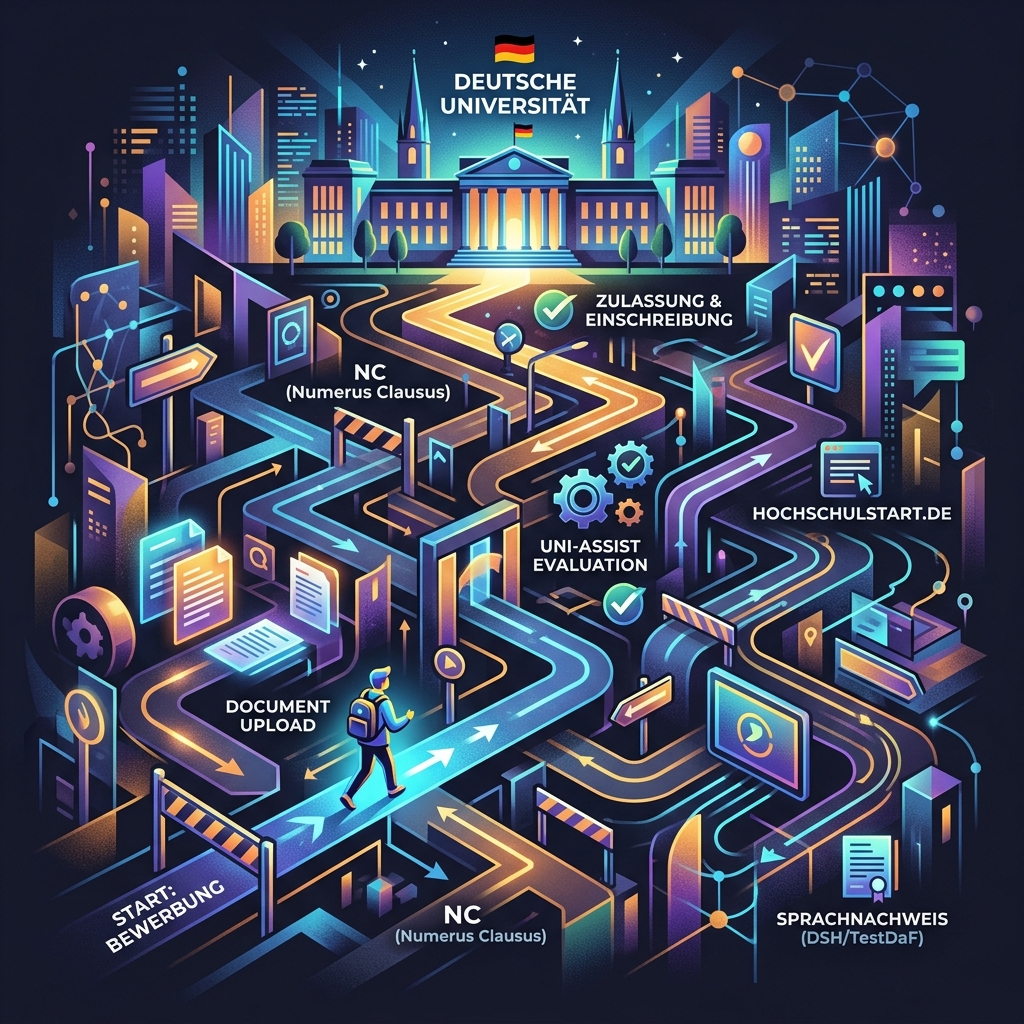
Most guides assume you'll go through Uni-Assist. You don't have to. Here's how to apply directly to German universities — for free.
Germany has some of the best universities in the world and, unlike most countries with that reputation, you can study there without paying tuition fees. For international students, that makes it an obvious destination.
What's less obvious is the fee that sneaks in through the application process itself.
Uni-Assist is a centralised service that many German universities use to process international applications. It costs €75 for your first application and €30 for each one after that. On top of document preparation, translations, and other costs, it adds up fast — especially if you're applying to multiple universities.
Here's the thing they don't advertise: a significant number of good German universities don't use Uni-Assist at all. You can apply directly to them, for free.
Why Uni-Assist Exists (and Why You Can Skip It)
Uni-Assist was set up to verify foreign qualifications and translate documents into a format German admissions offices can process. It's useful for universities that don't have the capacity to evaluate international credentials themselves.
But larger universities — and many technical universities — have their own international admissions offices with the staff to handle this directly. These institutions let you submit your application through their own portal, on their own timeline, with no Uni-Assist involved.
Universities That Accept Direct Applications
This is not a complete list, and programmes change, so always verify on the university's own admissions page. But as of my research, these are well-known institutions that offer direct application for many of their programmes:
- Heidelberg University — Germany's oldest university, direct applications for most international programmes
- LMU Munich (Ludwig Maximilian University) — major research university, own portal
- RWTH Aachen — top technical university, especially strong for engineering
- Technical University of Munich (TUM) — TUMonline handles applications directly
- University of Bonn — direct applications, well-regarded across disciplines
- University of Hamburg
- University of Cologne
- Goethe University Frankfurt — where I live, and I can confirm the process is manageable
- TU Berlin
- University of Stuttgart
- Free University of Berlin (FU Berlin)
- University of Freiburg
- University of Düsseldorf
- University of Münster
- Leibniz University Hannover
- TU Dortmund
- University of Göttingen
- University of Erlangen-Nuremberg (FAU)
A few of these do use Uni-Assist for specific programmes even while offering direct applications for others. Always check the admissions page for your exact programme before assuming.
How to Apply Without Uni-Assist
The process isn't complicated, but it requires some organisation.
Step 1: Choose your programme carefully
Before you apply anywhere, confirm on the university's own admissions page whether your programme requires Uni-Assist or offers direct application. The key phrase to look for is "apply directly" or "apply via [university portal name]." If the page says Uni-Assist, it means Uni-Assist for that specific programme.
Step 2: Read the exact admission requirements
Each programme has its own requirements — GPA minimums, language test scores (usually IELTS or TOEFL for English-taught programmes, TestDaF or DSH for German-taught ones), required documents, and sometimes motivation letters or recommendation letters. Read these carefully before you start gathering documents.
Step 3: Prepare your documents
Standard requirements across most German universities:
- University transcripts (often need to be officially certified)
- Degree certificate / graduation certificate
- Language test results
- Passport copy
- CV / résumé
- Motivation letter (common for Master's programmes)
- Proof of relevant work experience if required
Some universities require certified German translations of documents from non-English-speaking countries. This is where it's worth investing in a certified translator — it's a one-time cost and the certified copies can be used for multiple applications.
Step 4: Apply through the university's own portal
Most universities use one of a few systems — Movein, Mobility Online, or their own custom portal. The application is usually done entirely online. Upload your documents, fill in the form, and submit before the deadline.
Application deadlines in Germany are typically:
- Winter semester (starting October): apply by 15 July
- Summer semester (starting April): apply by 15 January
Step 5: Track your application
After submission, you'll get a confirmation with an applicant number. Use this to log into the portal and monitor your status. Response times vary — some universities reply in a few weeks, others take until just before the semester starts. Don't panic if you don't hear back quickly.
A Few Things I Wish Someone Had Told Me
German bureaucracy moves slowly but reliably. If you submitted everything correctly, it will be processed. Following up too aggressively doesn't help. One polite email if you're close to the deadline is fine.
The language requirement is non-negotiable. Don't apply to a German-taught programme without TestDaF or DSH. Don't apply to an English-taught programme without IELTS or TOEFL. No exceptions.
Blocked account before visa. If you get accepted, you'll need a blocked account (Sperrkonto) with roughly €11,208 for your visa application. Coracle and Expatrio are the most commonly used services for this — set it up early, it takes time.
Health insurance is mandatory. As a student in Germany you're required to have health insurance. Public student insurance (TK, AOK, Barmer) is around €120/month and covers you properly.
The process is manageable. Germany genuinely wants international students — the universities are set up for it, the cities are used to it, and once you're in, you'll find it was worth the paperwork.
Good luck.