Building in Public vs Staying Quiet: What Actually Helps a Startup Grow
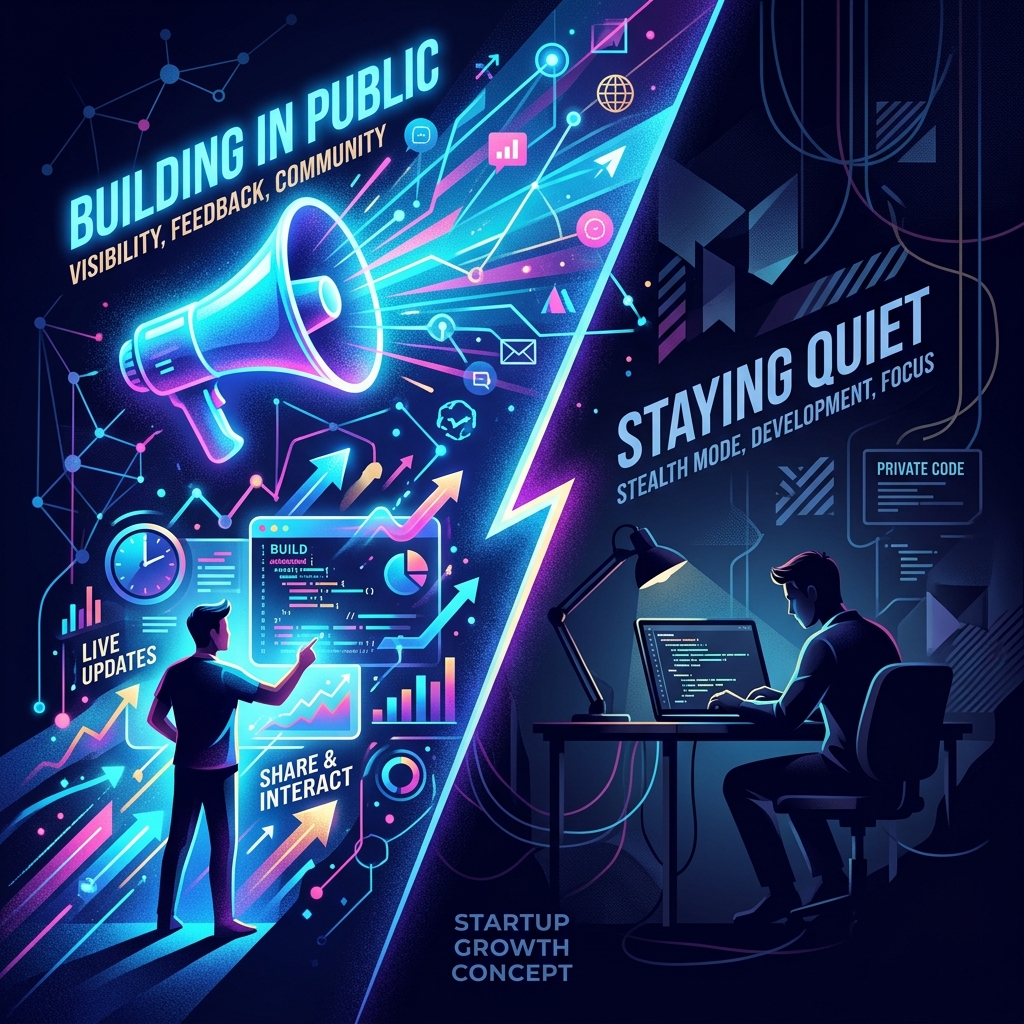
Twitter tells you to build in public. Your competitors don't. Here's an honest look at when each approach makes sense.
"Build in public" became a mainstream startup philosophy around 2020–2021. Founders sharing their revenue numbers, subscriber counts, decision-making processes, and failures on Twitter (now X) in real time. The case for it is compelling: transparency builds audience, audience builds trust, trust converts to customers. Several founders built meaningful businesses on the back of public building narratives — Pieter Levels, Arvid Kahl, many others.
The case against it is less well-articulated but also real. Here's when each approach makes sense.
What Building in Public Actually Means
It's worth being precise because the term covers a range of behaviours:
Revenue transparency: Publishing your MRR (monthly recurring revenue) on your website or Twitter. Common among indie hackers and solo founders.
Milestone sharing: Announcing first customer, first £1k MRR, first hire, product launches. Lower vulnerability than revenue sharing, high signal value.
Process sharing: Writing about how you made a decision, why you built a feature, what you're experimenting with. High value for building authority and audience.
Failure and struggle sharing: Writing about what didn't work, customers who churned, months where nothing happened. High authenticity signal, high vulnerability.
These are meaningfully different. You can share process and milestones without sharing revenue numbers. You can be transparent about your thinking without narrating your failures in real time.
The Case For Building in Public
Distribution: Content about your startup is free marketing. Every post about what you're building is reaching people who may become customers, collaborators, investors, or employees. For a founder with no marketing budget and no existing audience, building in public is one of the few ways to build distribution from scratch.
Accountability: Telling people publicly what you're building creates accountability that many founders find motivating. The audience becomes a commitment device.
Community: Building an audience around the building process creates a community that can become a competitive moat. Customers who followed your journey from the beginning have a different relationship with your product than customers who found you through a Google ad.
Feedback: Publishing your thinking publicly invites responses. Some of those responses are noise. Some are from people who have your problem and will tell you exactly what they need.
Recruitment and investment: Investors who've watched a founder build in public over 18 months have significantly more information than one who appears with a deck and a pitch. Some investors specifically follow the build-in-public community.
The Case Against
Competitive exposure: In most businesses, your strategy, your product roadmap, your customer acquisition costs, and your revenue metrics are competitively sensitive. Publishing them publicly is informing your competitors.
For B2B software, enterprise products, or markets where you're competing against well-resourced companies, building in public hands competitors information about what's working and what you're building next. This is a real cost that public building advocates underweight.
Distraction: The dopamine feedback loop of Twitter engagement and newsletter subscriber counts can become a substitute for doing the hard things — calling customers, fixing the product, closing deals. Some founders find they're building a content business around a startup rather than building the startup itself.
The survivorship problem: The build-in-public founders who are celebrated are the ones who succeeded. We don't see the equally public founders who failed with an audience watching. The sample is heavily biased toward the visible successes.
Valuation implications: Publishing MRR publicly sets a floor for what you're worth in investors' minds. If you're planning to raise, there's an argument for keeping revenue private until you have the context to frame it correctly.
Not all businesses suit it: Building in public works best for consumer and prosumer products where your customers are themselves creators and builders — the audience for your public building is your customer. For B2B enterprise products, industrial software, or businesses with conservative enterprise clients, the public narrative may actively undermine client confidence.
Who Should Build in Public
Solo founders and indie hackers with no marketing budget: The upside (free distribution, community, accountability) substantially outweighs the downside (competitive exposure is limited when you're a solo founder with no resources a well-funded competitor couldn't just outbuild).
Consumer products in the creator/maker/developer space: If your customers are creators, developers, or builders — the same people who follow build-in-public content — then building in public reaches your exact audience.
Products where the founder's journey is part of the value proposition: Personal finance tools built by someone who escaped debt. Productivity software built by someone with ADHD. The authenticity of the founder's story is part of the product's appeal.
Who Should Stay Quieter
Businesses in competitive markets with well-resourced competitors: If you've found a product insight that gives you a competitive advantage, the time to exploit it quietly is before competitors know about it.
Enterprise B2B founders: Your enterprise customers and prospects care about stability, security, and reliability — not the founder's emotional journey. Public vulnerability signals may undermine the trust you need in this market.
Founders who already have distribution: If you have an existing network, investor relationships, or a content platform that doesn't depend on Twitter-style build-in-public, you're not missing the distribution benefit.
Businesses dealing with sensitive customer data: If confidentiality is part of your value proposition (legal tech, health tech, financial services), public building creates unnecessary tension with client trust.
The Middle Path Most Founders Actually Take
The real answer for most founders is neither fully public nor fully private. The useful middle:
- Share the strategic thinking (why you made a decision) without sharing the numbers
- Publish the lessons (what you learned from a mistake) without narrating the mistake in real time
- Share milestones that are genuinely interesting to your target customer, not every metric
- Build audience on a topic that's adjacent to your product rather than on the product-building process itself
A founder building a travel tech product who writes extensively about the travel industry, GDS systems, and international payment complexity is building an audience of the right people — potential customers, industry peers, potential hires — without revealing their competitive strategy.
That's more valuable long-term than MRR charts on Twitter.
One Honest Observation
The build-in-public founders who have the most durable businesses tend to be ones whose business model doesn't depend on the public building narrative for growth. The narrative accelerates early traction. The business then grows on its own merits — because the product is genuinely good, because the market is there, because the fundamentals are right.
Building in public is a distribution strategy. It's not a business model. The founders who treat it as a business model end up with large audiences and businesses that don't survive without the audience's attention. The ones who treat it as one channel among several end up with both.